Thursday, August 27, 2026 - 03:02 PM
Subscribe/Login
Justice Leonen: Human Intelligence Irreplaceable by AI in the Legal Realm

Justice Leonen: Human Intelligence Irreplaceable by AI in the Legal Realm

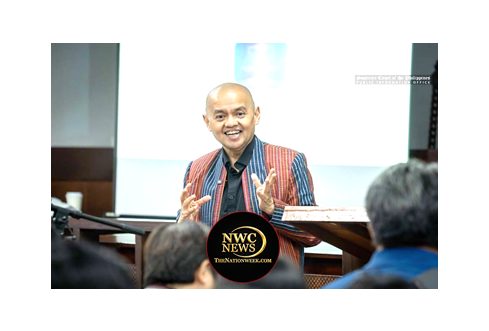
On August 20, 2026, then Acting Chief Justice Marvic M.V.F. Leonen discusses the use of Artificial Intelligence during a lecture on “The Critical Use of AI: Challenges for the Philippine Legal Profession and the Judiciary” at the Supreme Court (SC) Session Hall in Baguio City. (Photo courtesy of the SC Communications Office)

Justice Leonen: Human Intelligence Irreplaceable by AI in the Legal Realm

By Bing Jabadan – TheNATIONWEEK.com | August 27, 2026

MANILA, Philippines – Acting Chief Justice Marvic M.V.F. Leonen has delivered a profound critique of Artificial Intelligence (AI)’s limitations within the legal sphere, asserting that human intelligence remains irreplaceable. In a lecture entitled “The Critical Use of AI: Challenges for the Philippine Legal Profession and the Judiciary,” Leonen illuminated the path forward for integrating advanced technology while safeguarding the foundation of human judgment.

Justice Leonen, who chairs the Court’s Committee on Human-Centered Augmented Intelligence, stressed that while AI offers undeniable assistance, its application must be critical, human-centered, and always subordinate to human discernment. This principle underpins the Judiciary’s “Governance Framework on the Use of Human-Centered Augmented Intelligence,” approved by the Supreme Court En Banc on Feb. 18, 2026. This framework, a cornerstone of the Strategic Plan for Judicial Innovations 2022-2027 (SPJI), champions technological advancement without compromising the essence of justice.

The Irreducible Chasm: Human Experience vs. Algorithmic Processing

The Supreme Court Public Information Office said Leonen, in a compelling address at the Supreme Court Session Hall in Baguio City on Aug. 20, 2026, distinguished between AI’s impressive capabilities and the profound depth of human understanding. While acknowledging AI’s fluency and contextual relevance, he declared these attributes fundamentally distinct from the multi-layered wisdom born of *lived experience, perception, and emotion.

The justice illustrated this critical divergence with compelling examples: “An AI model can parse a contract; it can analyze it, but it cannot tell you whether these two parties understood the words as they are written. A classifier used by a tech company can label a statement as positive or negative, but it cannot detect irony, regional idioms, or measure the distance between what a witness says and what a witness truly means.”

Beyond Digitalization: The Perils of AI’s “Confidence”

Leonen meticulously drew a crucial distinction between digitalization – the streamlined transfer of court processes to digital platforms – and AI. While digitalization enhances efficiency, accessibility, and resilience, AI operates on a different plane, engaging in prediction, classification, and generation, delving beyond “how” to “what” and “who.”

He also warned against the seductive confidence of AI systems, emphasizing that fluency is not synonymous with understanding, and this superficial assurance makes AI’s inherent errors particularly dangerous. “The difference between human thinking and that of AI can never be bridged by an update or the next release note,” he asserted, underscoring the fundamental gap that technology cannot close.

The Cultural Tapestry of Human Wisdom

Leonen further cemented his argument by highlighting the cultural embeddedness of human intelligence. He explained that practical wisdom, cultivated through human experience, is felt, not merely computed. “Human intelligence is cultural. Intelligence dwells within language, relationships, and shared meanings. Evidence, credibility, and honor are built between people in a form of life. Kapwa names the identity shared before one distinguishes. Loob names the relational will a person is answerable for. A machine has no independent access to any of these.” This profound observation underscores AI’s inability to grasp the nuanced cultural and relational dynamics essential to legal interpretation and human interaction.

Defining the Critical Use of AI: Responsibility at the Forefront

In his exposition on AI utilization, Leonen delineated four distinct approaches: simple use, responsible use, ethical use, and ultimately, critical use. He defined critical use as placing the ultimate responsibility squarely on the human user: “Critical use means that when you use AI, you should be capable of catching its errors.”This mandate transcends mere functionality or benefit assessment, demanding active scrutiny and independent verification.

The justice passionately advocated for the “interval” – the crucial pause between receiving information and making a decision. This vital space empowers legal professionals and judges to reflect, weigh circumstances, and exercise authentic human judgment, rather than passively accepting AI-generated outputs.

While the Supreme Court prudently advances digitalization, exemplified by the AI-powered transcription tool Scriptix, which streamlines court proceedings while retaining human oversight, Leonen’s address served as a powerful reminder: AI remains a sophisticated tool, but the profound, culturally-rooted, and experientially-driven wisdom of human intelligence stands unreplicable, a non-negotiable cornerstone of justice. 

*         *         *

Influence the Influential. Power Truth. TheNATIONWEEK.com

More than news: we are a defining force in independent journalism, delivering rigorous, unbiased reporting to an engaged, opinion-shaping audience that values integrity. Partner with us to align your brand with trust, reach discerning leaders, and amplify your impact. Your message. Our mission. Unrivaled engagement. Email nationweek@yahoo.com today.

Leave a Reply

Back To Top