Wednesday, October 14, 2026 - 07:42 AM
Subscribe/Login
West Bank Bloodshed Escalates Amid Gaza Ceasefire Failure: Palestinian Killed, 16 Wounded in Settler Attacks

West Bank Bloodshed Escalates Amid Gaza Ceasefire Failure: Palestinian Killed, 16 Wounded in Settler Attacks

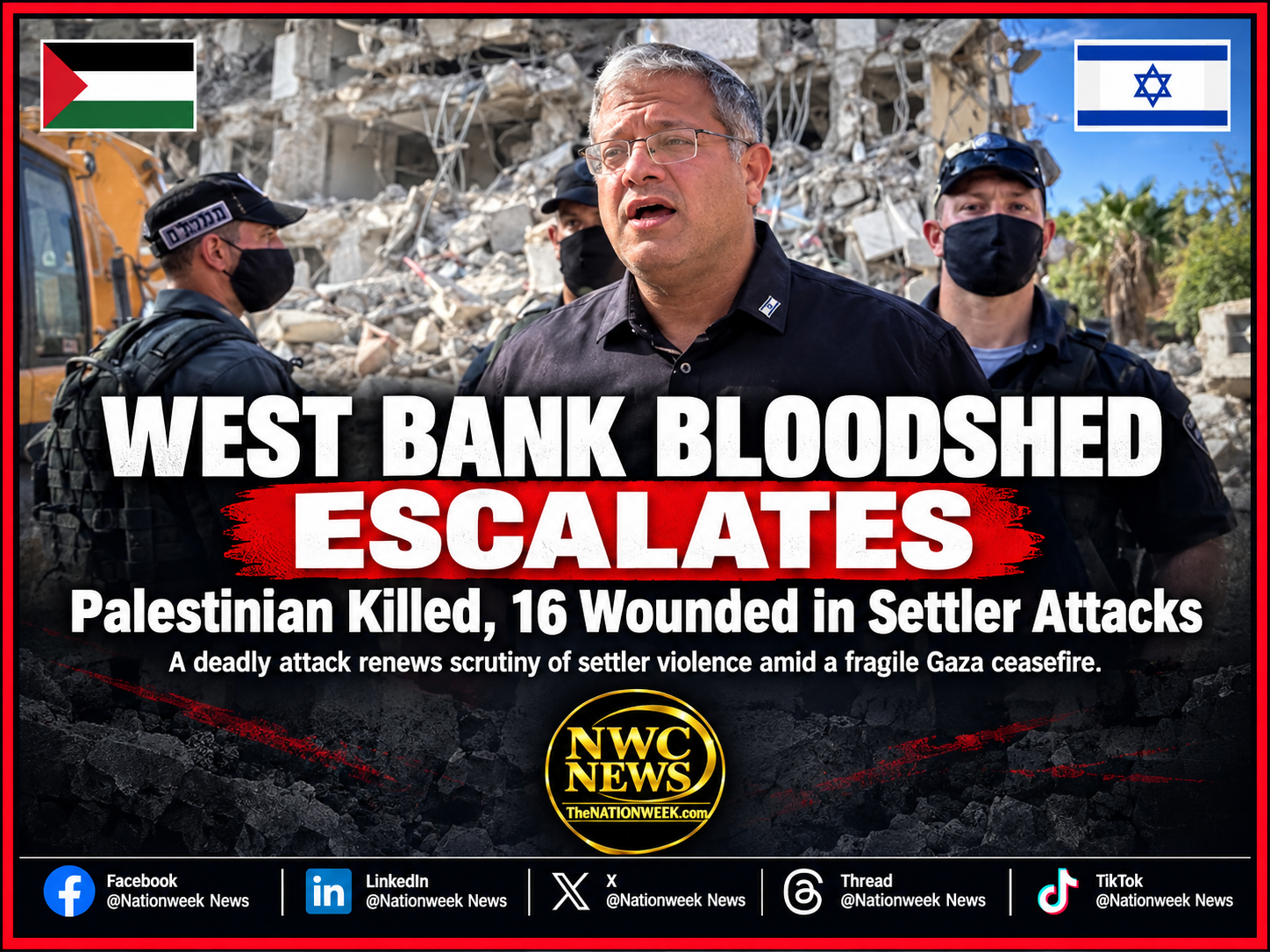
Israeli National Security Minister Itamar Ben-Gvir participates in the demolition of Palestinian homes in the occupied Palestinian territories.

West Bank Bloodshed Escalates Amid Gaza Ceasefire Failure: Palestinian Killed, 16 Wounded in Settler Attacks

By TheNATIONWEEK.com News Desk | October 12, 2026

OCCUPIED PALESTINIAN TERRITORY — The fragile illusion of a ceasefire in Gaza has done little to staunch the bloodshed in the occupied West Bank, where a Palestinian man was killed and at least 16 others sustained injuries in a wave of reported settler attacks targeting olive harvesters. These assaults, according to Palestinian authorities, underscore an escalating pattern of violence against civilians that persists across the territory, even as Israeli military actions in Gaza continue to claim lives.

Ali Hassan Yasser al-Bazzari, 44, of Burqa, northwest of Nablus, was killed during an assault near his village on Wednesday, October 7, 2026. His death highlights the increasing dangers faced by Palestinian farmers attempting to harvest olives on their own land during this critical agricultural season. The annual olive harvest, vital for Palestinian families’ economic survival and deeply embedded in their cultural heritage, is increasingly marred by threats, physical assaults, and restricted access to farmland.

Palestinian reports described the attack as a “settler pogrom” carried out with the alleged protection of Israeli forces. The reported involvement of armed settlers and military personnel raises serious questions regarding civilian protection, accountability, and the enforcement of international law in the occupied West Bank.

Injuries and Assaults on Medical Personnel Reported

Sixteen Palestinians sustained severe injuries in the attacks, with several, including a woman, requiring hospitalization in Tulkarem and Nablus, according to the Palestinian Wafa news agency. The Palestine Red Crescent Society (PRCS) treated five individuals at the scene, two with gunshot wounds and three with injuries from beatings.

The PRCS further reported that Israeli forces assaulted ambulance crews attempting to reach the injured, briefly detaining three paramedics and a volunteer. If confirmed, such interference with emergency medical personnel would constitute a severe breach of international humanitarian law, which protects medical workers and humanitarian responders.

The Palestinian Foreign Ministry condemned the violence as “war crimes” and urged the international community to uphold its legal and moral obligations to protect Palestinian civilians. This incident exemplifies a broader protection crisis: farmers facing aggression, injured civilians needing urgent treatment, and medical responders reportedly encountering violence while attempting to provide aid.

Olive Harvest Becomes a Season of Fear

These attacks are part of a growing pattern of violence during the olive harvest, a time when Palestinian landowners return to agricultural plots that are often difficult or dangerous to access. Al Jazeera correspondent Nida Ibrahim, reporting from Ramallah, noted how the threat of armed settler assaults and restricted access has transformed this traditional period of family gathering and agricultural work into a source of fear.

Olive cultivation provides essential income for many Palestinian households, and olive trees symbolize generations of land ownership, heritage, and continuity. Preventing farmers from reaching their orchards or destroying their trees thus threatens both livelihoods and the deep connection between communities and their land.

In separate incidents, Israeli armed settlers reportedly attacked Palestinians harvesting olives near Anata in the central occupied West Bank. Settlers also allegedly cut down at least 50 olive trees belonging to the Siam family after attacking the village of Mikhmas, northeast of occupied East Jerusalem. Such destruction can inflict long-term losses, as mature olive trees require years to replace and restore to productivity.

The Colonization and Wall Resistance Commission has reported widespread settler violence since October 7, 2023, with nearly 15,000 armed settler attacks recorded and 66 Palestinians killed in connection with such violence. These figures are attributed to the commission’s reporting and await independent verification.

Violence Spreads Across the Occupied West Bank

The assault near Burqa was not isolated. In Marda, north of Salfit, Palestinians harvesting olives were reportedly attacked by heavily armed settlers and Israeli forces. The PRCS treated individuals suffering from tear-gas inhalation, and Wafa reported the detention of at least three Palestinians by Israeli forces. In Jenin, a Palestinian man was reportedly wounded by live ammunition during an Israeli military raid near the al-Aqsa restaurant and hospitalized. Burqa also faced further restrictions, with reports of a Palestinian detention and a curfew imposed by Israeli forces as settlers raided the village east of Ramallah. These incidents collectively suggest a climate where violence, military operations, arrests, and movement restrictions compound risks for Palestinian communities. Establishing individual responsibility in each case requires investigation, but the reported pattern warrants urgent scrutiny by international bodies.

Gaza’s Ceasefire: A Fragile Illusion

The crisis in the West Bank unfolds alongside ongoing deaths and injuries in Gaza, where a ceasefire, effective October 10, 2025, has reportedly failed to halt civilian casualties or alleviate the humanitarian emergency.

According to Gaza Ministry of Health figures cited in reports, at least eight Palestinians, including an eight-year-old girl, were killed in separate Israeli attacks on the day described. Incidents included a drone strike in western Gaza City, a bombing near Haider Abdel Shafi roundabout, another drone attack in the Tuffah neighborhood, and further fatalities in northern Gaza and Khan Younis. Another account cited at least nine deaths and 65 injuries within a 24-hour period. These figures are reported and require independent verification for precise daily totals.

The Gaza Ministry of Health has also reported at least 1,481 Palestinians killed and 5,254 critically injured since the ceasefire began. Its broader cumulative figures cite at least 74,370 deaths and 175,371 injuries since October 7, 2023. These totals are attributed to the ministry and remain unverified by independent sources.

Over 100 humanitarian, human rights, and civil society organizations have warned that the ceasefire exists “in name only,” citing continued casualties and restrictions on essential supplies, equipment, and reconstruction materials. Documented restrictions impede the restoration of homes, health services, and basic infrastructure, prolonging the suffering of displaced and vulnerable families. A ceasefire must provide meaningful civilian protection and allow unhindered humanitarian assistance. Continued reports of deaths, injuries, and severe restrictions raise serious questions about the achievement of these objectives.

International Accountability: Beyond Condemnations

The killing near Burqa and the wider violence in Gaza and the occupied West Bank expose a critical gap between diplomatic commitments to civilian protection and the realities faced by Palestinians. International humanitarian law prohibits deliberate attacks on civilians, requires the protection of medical personnel and the wounded, and places obligations on an occupying power regarding civilian population protection. Whether specific incidents constitute war crimes depends on evidence, circumstances, and competent legal processes; political condemnations alone do not establish criminal liability.

The immediate priorities are clear: protect Palestinian farmers and other civilians from attacks, ensure unhindered access for emergency medical teams, independently investigate alleged abuses, hold those responsible accountable under applicable law, and remove unjustified barriers to humanitarian relief and essential civilian activity.

For Palestinian families, the consequences extend beyond deaths and injuries to lost harvests, destroyed trees, disrupted livelihoods, and the pervasive fear of returning to their own land. The death of a 44-year-old farmer during the olive harvest is more than an isolated tragedy. Alongside continuing reports of violence in Gaza and across the West Bank, it serves as a stark warning that declarations of restraint and ceasefire arrangements cannot substitute for effective protection, credible investigations, and accountability.

* * *

Support Fearless Journalism.  

Advertise with Us: nationweek@yahoo.com

Donate to Us via GCash: +639267015155.

Leave a Reply

Back To Top