Tuesday, September 29, 2026 - 02:51 PM
Subscribe/Login
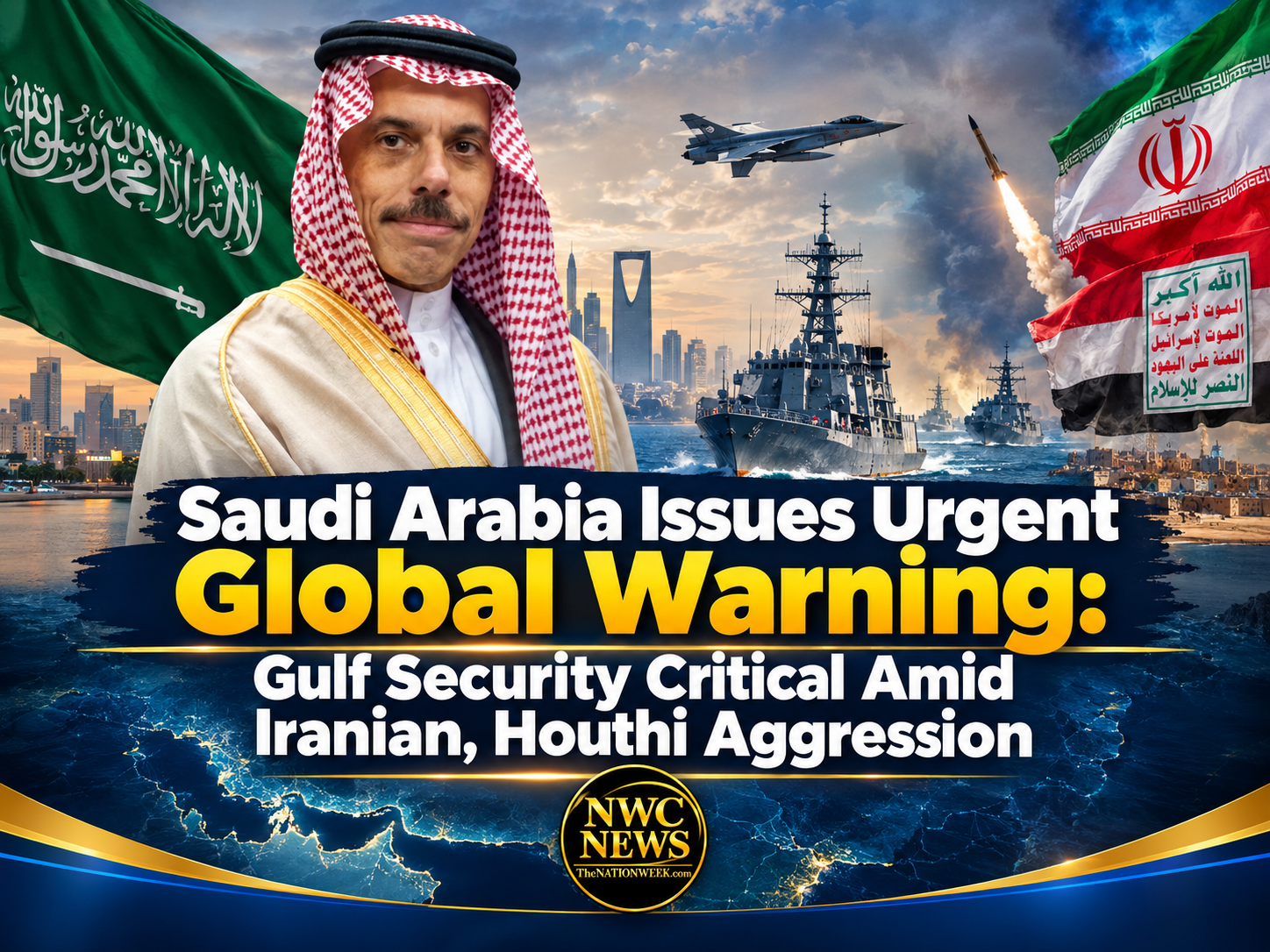
Saudi Arabia Issues Urgent Global Warning: Gulf Security Critical Amid Iranian, Houthi Aggression

Saudi Arabia Issues Urgent Global Warning: Gulf Security Critical Amid Iranian, Houthi Aggression

Saudi Arabia Issues Urgent Global Warning: Gulf Security Critical Amid Iranian, Houthi Aggression

By TheNATIONWEEK.com News Desk | September 29, 2026

NEW YORK – Saudi Arabia’s Foreign Minister, Prince Faisal bin Farhan, delivered a powerful address to the UN General Assembly on Saturday, September 26, 2026, condemning “flagrant” Iranian and Houthi aggressions and issuing a critical warning to the international community: “Gulf security is a vital global concern that demands serious and immediate attention.”

In a period marked by significant regional instability—including months of intense conflict involving the US, Israel, and Iran, alongside thousands of Iranian missile and drone attacks on Gulf states and Houthi militia assaults on Saudi Arabia—Prince Faisal underscored the interconnectedness of regional stability with global economic resilience.

“Any attempt to build sustainable relations in the region cannot be based on domination, influence, or the exploitation of crises,” Prince Faisal asserted. Instead, such relationships “must be founded on mutual respect, common interests, good neighborliness, respect for state sovereignty, and full compliance with international and humanitarian law.”

The Foreign Minister emphasized that current global crises stem not from a scarcity of resources but from a “lack of commitment to the principles agreed upon by the international community,” calling for collective responsibility in confronting threats to international peace and security.

Global Economic Stakes and Freedom of Navigation

Prince Faisal highlighted the Middle East’s critical importance, noting that its “stability is directly linked to global energy security, the steadiness of international trade, and the resilience of global supply chains.” He stressed that “safeguarding international navigation and the resilience of global supply chains is a shared responsibility that requires serious international cooperation.”

Specifically, he called for upholding freedom of navigation in crucial waterways, including the Strait of Hormuz, the Bab Al-Mandab Strait, the Red Sea, and the Gulf of Aden. He firmly rejected any Iranian attempts to impose fees or transit conditions on civilian vessels in Hormuz, asserting that the Kingdom “rejects the use by any party of these vital waterways as an instrument of pressure, threat, or harm to the interests of states in accordance with international law and relevant UN resolutions.”

Regional De-escalation and Disarmament

The Foreign Minister also detailed Saudi Arabia’s support for de-escalation and mediation efforts, referencing initiatives by Qatar and Pakistan, which he believes “would contribute to restoring stability to the region and creating conditions conducive to dialogue and diplomacy.” He stressed the necessity of “comprehensive, effective, and sustainable” regional security arrangements that “clearly address the root causes of threats and instability.” Prince Faisal additionally advocated for a Middle East free of weapons of mass destruction, with all civil nuclear programs subjected to rigorous international oversight.

Palestinian Plight and Yemeni Crisis

The Palestinian issue remained a central theme, with Prince Faisal condemning the “continued suffering of the Palestinian people in the Gaza Strip and the West Bank, and the targeting of civilians by the Israeli occupation, the obstruction of humanitarian assistance, attempts at forced displacement, and the continued expansion of illegal settlements” as “serious violations of international law and international humanitarian law.” He reiterated Saudi Arabia’s unequivocal rejection of any Israeli attempt to displace Palestinians and reaffirmed the Kingdom’s commitment to a two-state solution as the only viable path to conflict resolution.

Addressing the humanitarian crisis in Yemen, Prince Faisal highlighted Saudi Arabia’s substantial aid, exceeding $29 billion, making it a leading humanitarian donor. He welcomed the UN Security Council’s recent condemnation of Houthi missile and drone attacks against the Kingdom, urging the international community to “reject and condemn all Houthi terrorist aggressions and criminal acts that threaten the security of navigation in the Red Sea and Bab Al-Mandab Strait.”

Broader Regional Stability and Global Challenges

On Sudan, Prince Faisal called for an intra-national solution based on supporting Sudanese state institutions. He also welcomed the US removal of sanctions on the Syrian Arab Republic and praised its efforts toward stability. Advocating for state monopolies on arms in Lebanon and Iraq, he commended Baghdad’s progress in this area.

Vision 2030 and Global Contributions

Highlighting the success of Saudi Arabia’s Vision 2030, Prince Faisal noted its role in strengthening the Kingdom’s position as a regional and international hub for business, investment, tourism, industry, technology, and logistics.

He underscored global energy security’s vulnerability, asserting that it “rests on its capacity to withstand and adapt to disruptions, ensure the stability of energy supplies, protect critical infrastructure, diversify supply routes, and safeguard freedom of navigation.” He highlighted Saudi Arabia’s commitment to energy security through long-term infrastructure investments, such as the East-West Pipeline, and its role in mitigating supply disruptions through petroleum reserves.

Prince Faisal also proudly stated Saudi Arabia’s position as “one of the countries with the lowest carbon and methane emissions globally from hydrocarbon resource production operations,” detailing ongoing efforts in emissions reduction technologies, renewable energy expansion, and the production of sustainable fuels like clean hydrogen.

Concluding, Prince Faisal emphasized that confronting “unprecedented challenges” demands “the greatest possible measure of wisdom, responsibility, and cooperation.” He affirmed that security can only be sustained through adherence to the UN Charter and international law, pledging Saudi Arabia’s continued partnership with the international community to advance sustainable development, peaceful crisis resolution, and pathways that reinforce stability for a safer and more prosperous future.

Leave a Reply

Back To Top