Thursday, October 29, 2026 - 10:07 PM
Subscribe/Login
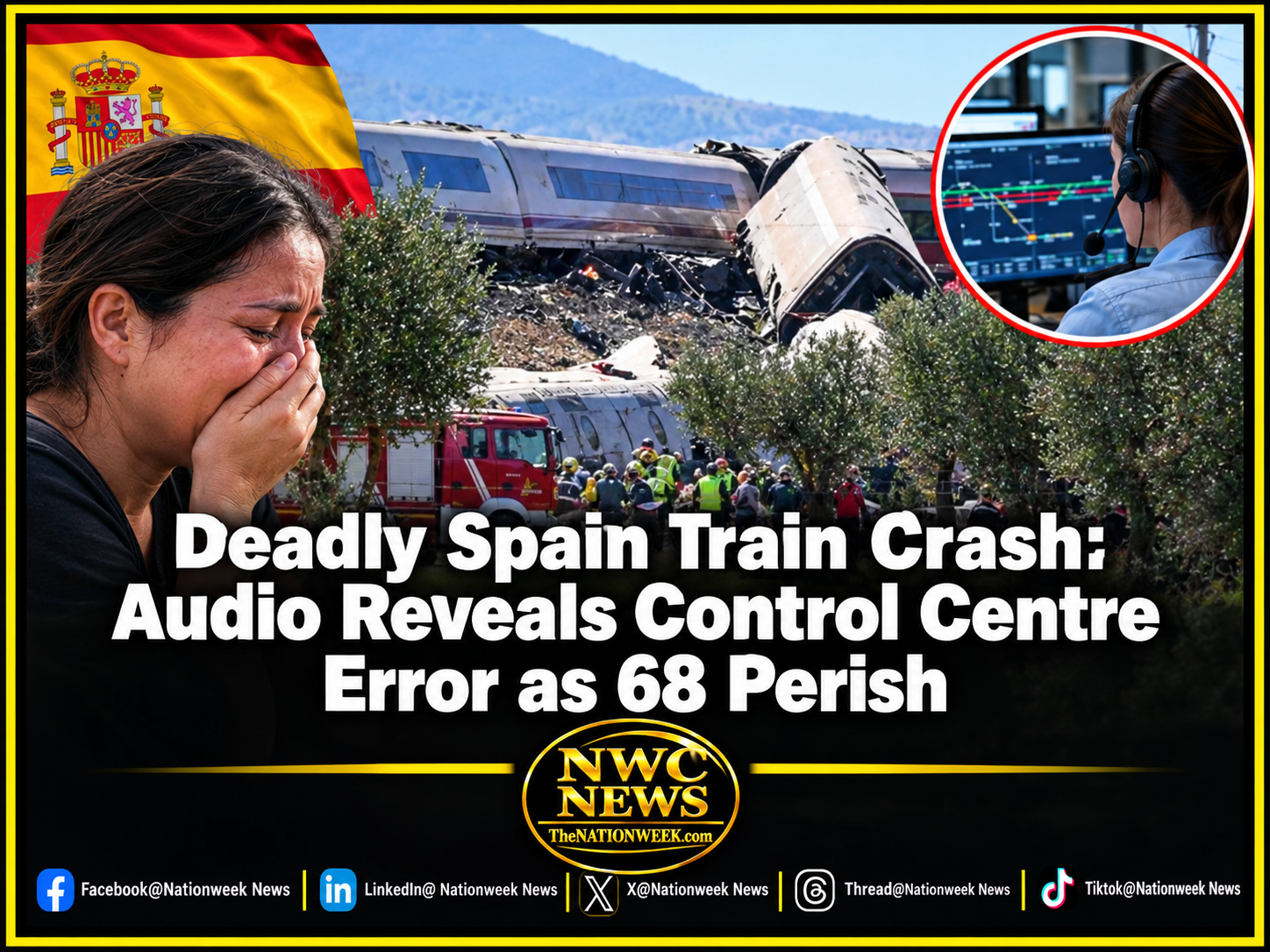
Deadly Spain Train Crash: Audio Reveals Control Centre Error as 68 Perish

Deadly Spain Train Crash: Audio Reveals Control Centre Error as 68 Perish

Deadly Spain Train Crash: Audio Reveals Control Centre Error as 68 Perish

By Paul V Young – TheNATIONWEEK.com | October 29, 2026

URDA, SPAIN – A catastrophic train collision in Spain has claimed the lives of 68 individuals and injured dozens, as investigators scrutinize alarming audio recordings that reveal a critical miscommunication between a railway control center and train drivers prior to the disaster. The incident, which occurred Wednesday morning, involved a high-speed Renfe train carrying 397 passengers striking a stationary Iryo train with 147 passengers on the same line.

Spanish authorities have launched an intensive investigation into the cause of the collision, which Prime Minister Pedro Sánchez vowed to probe “to the bottom of every last detail.” The tragedy has plunged Spain into three days of national mourning for one of Europe’s most severe modern rail accidents.

Crucial Audio Exposes Systemic Failure

Recordings obtained by investigators expose a chain of events suggesting a profound control error. A reported failure in the automatic signaling system, a computer malfunction, initially halted all trains on the affected track. However, subsequent directives from the Madrid control center tragically countermanded this safety measure.

In a pivotal exchange, a control center operator instructed the driver of the trailing Renfe train to “continue your journey and then proceed under [Lateral Signalling Block], at normal speed with normal operation.” When the driver questioned, “At normal speed?”, the controller affirmed, “Yes.” The Lateral Signaling Block is an emergency backup, typically activated only when the primary automatic system fails; yet its activation here seemingly bypassed a critical alert.

Further recordings reveal that the Iryo train’s driver had repeatedly communicated a loss of connection with the train-control system, confirming that the train was “stationary in front of the entry signal at Urda” and unable to resume movement. This crucial information appears to have been overlooked or misprocessed as the Renfe train was cleared to proceed. The Iryo driver’s subsequent, desperate message – “The train won’t allow me to control the [security] system. That’s why I am still stopped in front of the entry signal” – strongly indicates that the control center was notified of the stationary train even as the Renfe train approached at speed.

“Inexplicable” Error and Political Fallout

Spain’s Transport Minister Óscar Puente described the decision to allow trains to resume without speed restrictions as “inexplicable.” The premature release of the audio recordings has sparked political controversy, with some officials decrying the leaks as “despicable” and questioning the timing.

Left-wing parties have been quick to criticize, with Podemos prime ministerial candidate Irene Montero emphasizing that responsibility should not be solely placed on a single worker, highlighting long-standing warnings from railway experts about the risks of railway sector liberalization.

Prime Minister Sánchez, speaking from the crash site, reiterated the government’s commitment to supporting victims’ families and “strengthening safety measures to ensure it never happens again.”

Public Outcry and Ongoing Strike

The disaster has ignited public fury. Overnight, approximately 1,500 people gathered outside the Spanish Transport Ministry in Madrid, demanding the resignations of Sánchez and Puente. Protesters, dispersed by police with tear gas after throwing bottles and flares, underscored deep-seated concerns over the nation’s rail infrastructure.

Adding to the turmoil, rail drivers proceeded with a planned strike on Thursday, citing “the defense of railway safety” as their primary motivation. Alberto Núñez Feijóo, leader of Spain’s main opposition People’s Party, asserted, “Spain has the right to know what is happening with its infrastructure.”

Gruesome Recovery and Identification Efforts

Emergency teams worked through the night, using powerful floodlights to extricate victims from the mangled carriages. Hundreds of personnel, aided by drones and helicopters, were deployed to the disaster site. The Spanish Civil Guard confirmed that over 900 specialists were involved, with the immediate priority being the identification of remains, urging families of the missing to provide DNA samples at established local centers.

Witnesses recounted “chaotic scenes,” describing crying and bleeding passengers, individuals trapped in seats, and smoke engulfing the carriages, one of which caught fire. Relatives are desperately seeking information about their loved ones, with special bureaus set up in Madrid, Toledo, Seville, and Córdoba.

This catastrophe marks Spain’s deadliest rail accident since 2013, when 80 lives were lost near Santiago de Compostela. The ongoing investigation is expected to shed further light on the precise chain of command failures that led to this tragic loss of life.


*             *             *

Your support fuels independent and fearless journalism.

To advertise with us, please contact us today at: nationweek@yahoo.com.

You can also make a donation via GCash at: +639267015155.

Leave a Reply

Back To Top