Wednesday, November 25, 2026 - 04:12 PM
Subscribe/Login
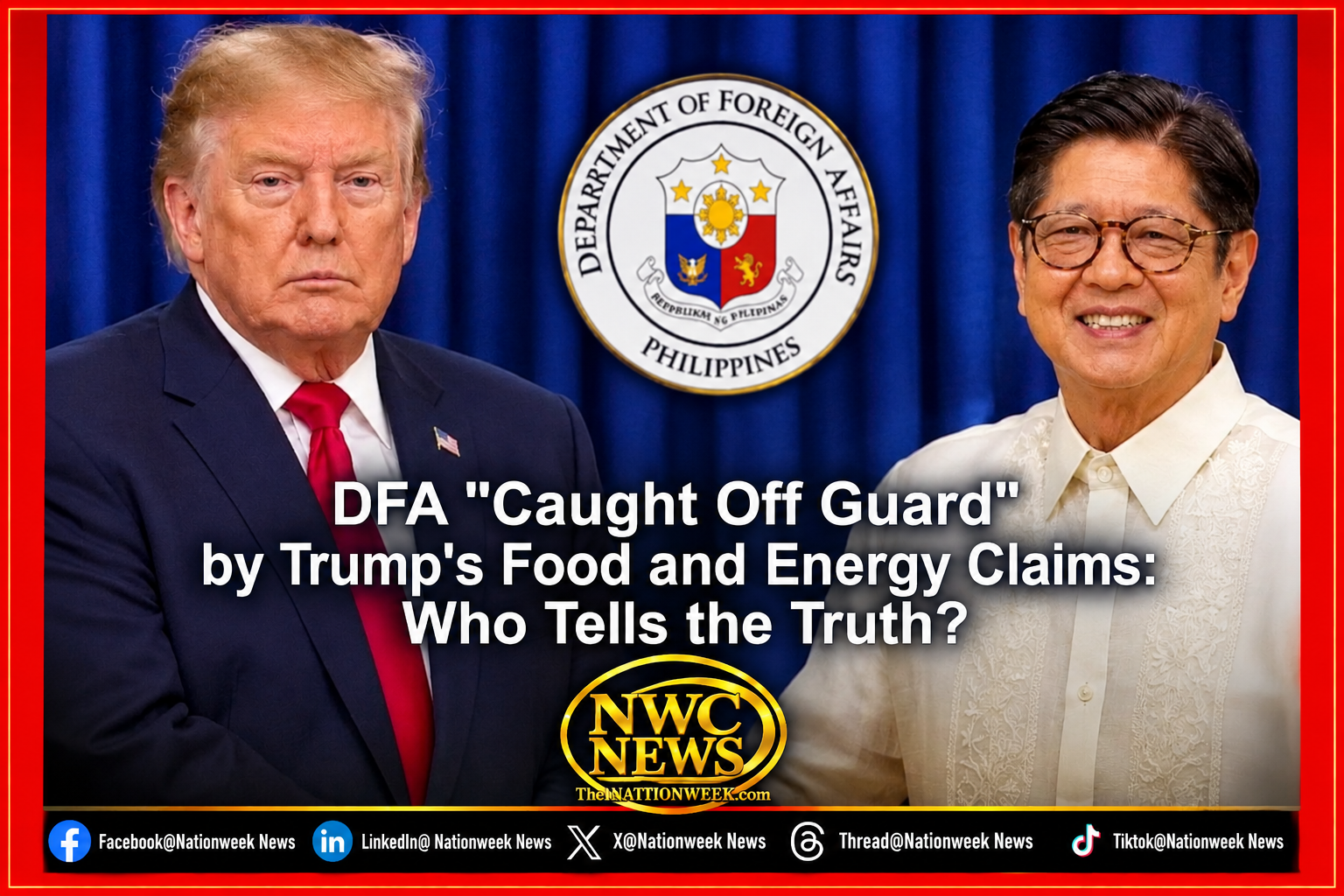
DFA “Caught Off Guard” by Trump’s Food and Energy Claims: Who Tells the Truth?

DFA “Caught Off Guard” by Trump’s Food and Energy Claims: Who Tells the Truth?

DFA “Caught Off Guard” by Trump’s Food and Energy Claims: Who Tells the Truth?

By NATIONWEEK News | November 25, 2026

MANILA, Philippines – A bombshell pronouncement from the White House, where US President Donald Trump asserted the Philippines’ commitment to exclusively source its agricultural and energy needs from the United States, has plunged Manila into an unprecedented diplomatic and economic quagmire.

The Department of Foreign Affairs (DFA), the nation’s vanguard of international relations, chillingly admitted it was “taken aback” – even “caught off guard” – by Trump’s definitive declaration, igniting a firestorm of questions about the integrity of the nation’s economic autonomy and the veracity of bilateral discussions.

This extraordinary claim, delivered by Trump following a bilateral meeting with President Ferdinand R. Marcos Jr., has exposed a startling divergence between the two nations’ public narratives.

While Malacañang cautiously suggests that no definitive agreement has been reached, the stark certainty of Trump’s statement clashes violently with the Philippine government’s nuanced, almost bewildered position.

The question looms large: Who is telling the truth? And what are the profound implications for Philippine sovereignty?

A Unilateral Declaration vs. Deliberate Consideration: A Dangerous Discrepancy

“The Philippines has yet to agree on specific terms for a supposed trade deal that would require the country to source all its agricultural and energy needs from the United States,” clarified Palace Press Officer Claire Castro, attempting to temper the escalating alarm. She underscored the government’s stance, emphasizing that such a radical, potentially crippling import policy would only be considered if it demonstrably benefits Filipinos, particularly in terms of competitive pricing and the absence of viable alternative suppliers.

“A 100 percent sourcing from the US, if they are the sole and cheapest provider, presents an attractive option. However, we must always evaluate other sources and more economical alternatives,” Castro stated, adding that any future agreement must rigorously safeguard Philippine interests and prevent any disadvantage to local industries.

Her carefully chosen words, however, stand in stark contrast to Trump’s categorical assertion, suggesting either a colossal misunderstanding or a deeply unsettling unilateral imposition. Castro further indicated that current discussions are primarily focused on expediting potential transactions and defining the roles of respective representatives – a far cry from a full-fledged, exclusive sourcing commitment.

DFA’s Astonishment and Legislative Scrutiny: “Kept in the Dark”

The true extent of the Philippine government’s unpreparedness for Trump’s announcement became starkly evident during a recent Senate budget hearing. The Department of Foreign Affairs acknowledged its surprise, admitting it was “caught off guard” by the US President’s bold claim regarding the Philippines’ future agricultural and energy sourcing.

Senator Imee Marcos, expressing “extreme alarm” and concern, directly questioned the DFA’s apparent lack of involvement in what seemed to be a significant policy shift. She highlighted the unsettling incongruity of a US presidential announcement of such magnitude without prior engagement from the Philippines’ lead foreign policy agency.

A senator sponsoring the DFA’s budget disclosed a critical detail: the issue of exclusively importing agricultural and other commodities from the US was raised for the first time during the bilateral meeting on the sidelines of the ASEAN Summit in Manila.

“Everyone was taken aback because this issue was only brought up during the bilateral meeting between the two presidents,” he revealed.

He added that prior discussions had solely revolved around tariffs, with no mention of such an expansive import mandate.

Senator Marcos characterized this as an “admission on the part of the DFA that they were kept in the dark regarding this announcement.” Her observation, “it appears matters have now been assigned to others,” chillingly suggests a potential circumvention of established diplomatic channels and a troubling shift in the handling of these critical economic negotiations, raising questions about accountability and transparency.

It was subsequently clarified that economic agencies, specifically the Department of Trade and Industry (DTI) and the Department of Agriculture (DA), are now slated to take the lead on this “more economic issue” – a move that further sidelines the DFA from a matter of profound international implications.

The January 1 Deadline: “Extreme Alarm” and the Unanswered Questions That Threaten Sovereignty

Senator Marcos’s “extreme alarm” resonated deeply with the public, particularly her pointed question regarding Trump’s assertion that the Philippines would commence sourcing 100 percent of its agricultural products and all its energy requirements from the United States starting January 1, 2027.

“While the Palace has stated time and again that the matter is still under study, the fact remains that an agreement apparently was reached,” she stressed, highlighting the unsettling discrepancy between the two nations’ public postures. This raises a critical question: Was a commitment made in secret, or is Trump’s statement a deliberate act of diplomatic pressure, even coercion?

She further pressed whether the DFA, the very agency responsible for safeguarding the nation’s external relations, had been entirely excluded from the substantive discussions between the two presidents during not only the ASEAN but also the APEC meetings – a possibility that is deeply concerning for democratic governance.

The DFA, through the sponsoring senator, offered a tepid response, confirming it is actively monitoring developments and awaits further clarification from its American counterparts. A planned bilateral meeting between the Philippines and the United States in March 2027 is anticipated to provide further answers – but for a commitment allegedly set to begin just weeks later, this timeline seems dangerously delayed.

This escalating diplomatic entanglement underscores the immense complexities of international relations and the perilous potential for unilateral declarations to create significant geopolitical and economic ripples that threaten national sovereignty. The Philippines now faces the critical task of clarifying its position, safeguarding its national interests, and navigating the profound implications of such a far-reaching, potentially binding, and as yet unverified proposed trade commitment.

Trump’s 100% Claim: What did Marcos Agree To?

The source of this diplomatic firestorm traces back to U.S. President Donald Trump himself. In a press conference following his attendance at the 33rd APEC Economic Leaders’ Meeting, which took place in Shenzhen, China, Trump made a sweeping declaration that the Philippines had agreed to source 100% of its energy and agricultural products from the U.S.

“Energy, they buy 20% from us but they buy… ‘Where do you get your energy?’ President Marcos, who’s a very good man, by the way. Great family, but I said, ‘Where do you buy your energy?'” Trump recounted, mistakenly referring to President Marcos as a Prime Minister. “‘Sir, we buy it from the Middle East.’ I said ‘not anymore, you don’t. You’re gonna buy 100% of your energy from us,'” Trump added with characteristic bluntness.

He further asserted that the Philippines had agreed to import 100 percent of its farm products from the US instead of Brazil, framing it as a matter of national security: “saying it won’t help the country in case it gets attacked by China.” This statement, tying economic dependency to geopolitical vulnerability, is particularly alarming.

The Missing Agreement: A Crisis of Transparency

The discrepancy between Trump’s definitive pronouncements and the Philippine government’s cautious responses highlights a dangerous lack of transparency. The White House’s November 18 fact sheet, while noting a commitment to addressing the US trade deficit through increased Philippine imports of American agricultural and energy products, conspicuously omitted any mention of a 100% import requirement, a January 1 deadline, specific purchase volumes, or a binding procurement schedule.

President Marcos, speaking to reporters in Shenzhen, China, on November 20, offered a markedly different account. He framed the discussions as exploring opportunities to diversify the country’s suppliers and secure more affordable imports, citing possible increased purchases of soybeans, wheat, and petroleum products – a far cry from an exclusive, 100% commitment. Philippine Ambassador to the United States Jose Manuel Romualdez echoed this, confirming no agreement had been signed. Energy Secretary Sharon Garin further reinforced that negotiations were ongoing and that the government had yet to commit to purchasing *all* its agricultural and energy requirements from the United States.

The Critical Questions Demanding Immediate Answers:

The conflicting accounts leave critical questions unanswered, threatening the very fabric of Philippine economic sovereignty:

  1. What was actually discussed and agreed upon? Did President Marcos accept Trump’s proposed 100% purchasing commitment, or did the two governments merely agree to explore additional American imports?
  2. Where is the agreement? If such a sweeping commitment was made, why has it not been published?
  3. What quantities, products, prices, and implementation dates are being considered?
  4. What concessions, if any, is Washington offering Philippine exporters in return for such a dramatic shift in trade policy?
  5. Will any arrangement impose minimum purchasing obligations or restrict the country’s ability to source supplies from other trading partners, thereby undermining its economic independence and leverage?

The Philippines relies on a diverse network of international suppliers for food, petroleum, and other energy requirements. Replacing that critical network with absolute dependence on a single country would carry significant, potentially catastrophic, economic and strategic consequences, placing the nation at the mercy of a singular foreign power.

The administration cannot, and must not, leave the public to reconcile two materially different accounts of a presidential agreement. If no exclusive purchasing commitment was made, President Marcos must state so unequivocally. If one was indeed made, the government has an obligation to immediately publish its terms, explain its mechanisms, and justify how it unequivocally protects Philippine economic interests and national sovereignty.

A deal described by Washington as completed, yet by Manila as still under negotiation, demands more than presidential assurances or diplomatic evasions. The public deserves the full, unredacted agreement, its actual obligations, and a transparent accounting of the concessions secured for the Philippines. Anything less is a disservice to the nation and a dangerous erosion of trust and sovereignty.

[Note: AI technology was used to generate the thumbnail.]

*          *          *

Your support fuels independent and fearless journalism.

To advertise with us, please contact us today at: nationweek@yahoo.com.

You can also make a donation via GCash at: +639267015155.

Follow Us On Social Media

Leave a Reply

Back To Top