Wednesday, September 16, 2026 - 05:54 PM
Subscribe/Login
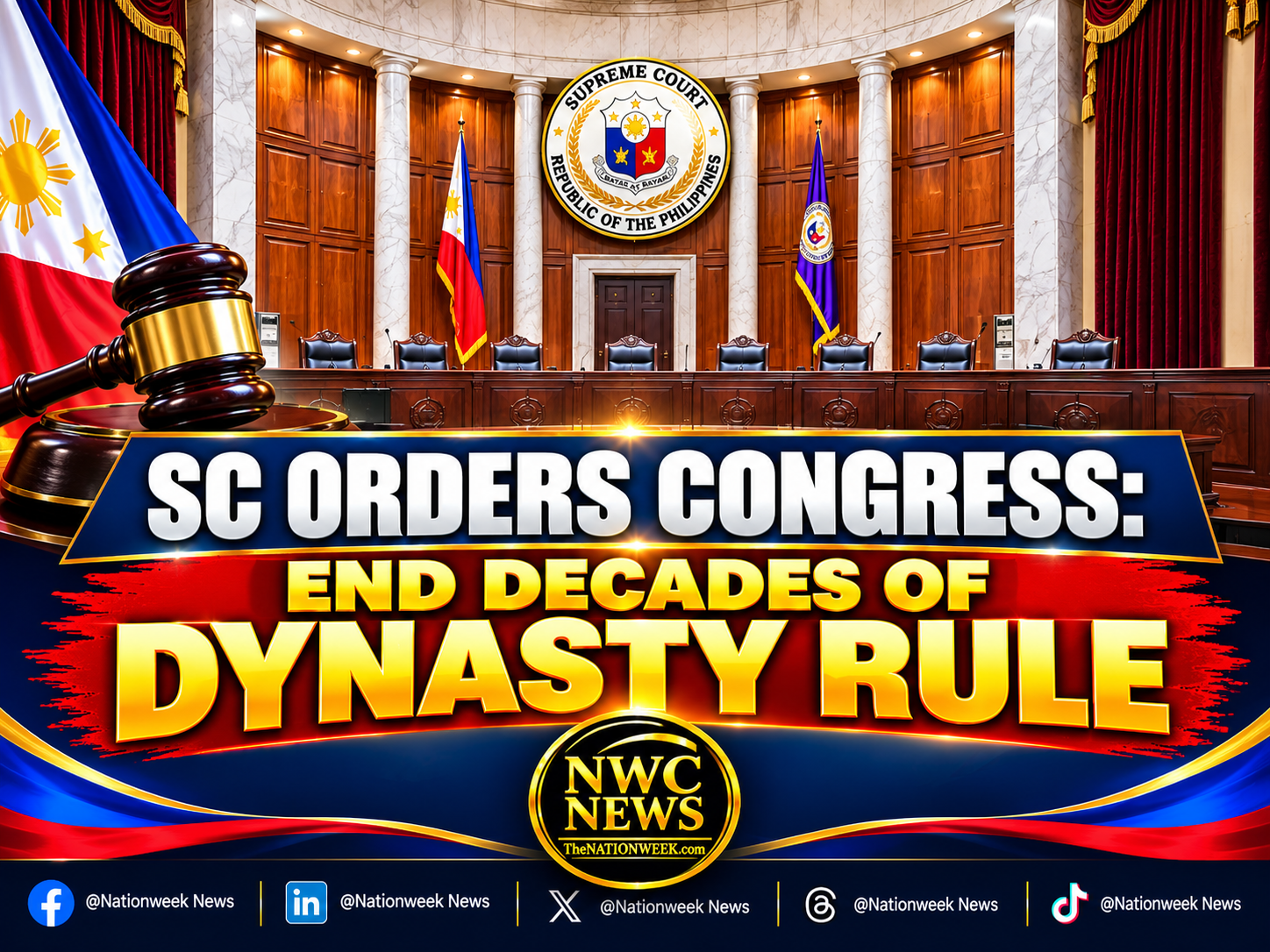
SC Orders Congress: End Decades of Dynasty Rule

SC Orders Congress: End Decades of Dynasty Rule

SC Orders Congress: End Decades of Dynasty Rule

By TheNATIONWEEK.com News Desk | September 16, 2026

MANILA, Philippines – In a landmark decision poised to reshape the Philippine political landscape, the Supreme Court En Banc has unequivocally declared Congress’s 39-year failure to enact an anti-political dynasty law a blatant violation of the Constitution, constituting grave abuse of discretion. The Court’s unified and historic ruling delivers a direct mandate to the legislature: legislate now, dismantle a legacy of dynastic entrenchment, and fulfill a foundational promise of democratic governance.

Issued on August 26, 2026, the comprehensive judgment consolidates four critical petitions: Kapatiran Party et al. v. Congress of the Philippines; Wilfredo M. Trinidad et al. v. Congress; Bishop Gerardo A. Alminaza et al. v. COMELEC; and 1Sambayan Coalition et al. v. Senate of the Philippines. Penned by Associate Justice Ramon Paul L. Hernando, the decision represents a definitive break from cautious judicial precedent, signaling a new era of accountability for legislative inaction.

The Unfulfilled Constitutional Mandate

Central to the ruling is Article II, Section 26 of the 1987 Constitution, which declares with absolute clarity: “The State shall guarantee equal access to opportunities for public service and prohibit political dynasties as may be defined by law.”

For nearly four decades, Congress strategically leveraged the phrase “as may be defined by law” as a shield, claiming discretionary power to defer or even abandon this constitutional imperative. The High Court decisively dismantled this defense.

“The word ‘shall’ is not optional; it is a command,” the justices asserted. “Congress possesses no discretion to avoid prohibiting dynasties. Its authority is limited solely to defining the scope and parameters of that prohibition.”

The Court meticulously confirmed the framers’ original intent: in the absence of consensus on specific definitions and boundaries, the duty to codify the prohibition was unequivocally entrusted to Congress, not granted as an option for indefinite abandonment.

Decades of Deliberate Inaction, Entrenchment of Dynasties

The ruling exposes a calculated pattern of legislative neglect that has allowed dynastic control to metastasize across the archipelago:

Systematic Obstruction

Dozens of anti-dynasty bills, introduced in every Congress since 1987, were systematically shelved, diluted, or outright killed.

Pervasive Control

Dynastic influence has not only broadened but deeply penetrated, extending even into the party-list system, ostensibly designed to empower marginalized sectors.

Insufficient Measures

Existing restrictive provisions, confined to the Sangguniang Kabataan Reform Act and Bangsamoro codes, are partial, geographically limited, and woefully inadequate to satisfy the nationwide, comprehensive ban mandated by the Constitution.

Stifled Democracy

The concentration of power within a select few families has demonstrably narrowed electoral competition, suppressed the emergence of new leadership, and entrenched systemic inequality, suffocating the vibrancy of Philippine democracy.

“Thirty-nine years transcends reasonable delay,” the Court pronounced. “It constitutes a continuous and deliberate refusal to perform a clear constitutional duty.”

Overturning Precedent: Mandamus Granted for Constitutional Preservation

Crucially, the justices formally overturned their own 2013 rulings in Biraogo v. COMELEC and Guingona v. Congress, which had previously deemed Section 26 non-self-executing and beyond enforcement by mandamus. The Court now asserts that these earlier decisions no longer reflect either the framers’ unequivocal intent or the corrosive, undeniable reality of dynastic rule.

The majority ruled that this case represents an extraordinary, compelling exception: when a co-equal branch of government persistently refuses to discharge a clear, mandatory constitutional duty, judicial intervention ceases to be an intrusion and becomes the judiciary’s solemn obligation – a direct defense of the Constitution itself.

The Court made it clear: it will not dictate the specific terms of the law. Definition, scope, potential exemptions, and enforcement mechanisms remain the exclusive prerogative of Congress. However, the fundamental act of legislating the prohibition is no longer discretionary.

COMELEC’s Hands Tied: The Void Congress Must Fill

The petition against the Commission on Elections (COMELEC) was denied. The Court affirmed that without a duly enacted law defining political dynasties, COMELEC lacks the legal authority to unilaterally disqualify candidates or cancel certificates of candidacy based on dynastic affiliation. The power to define this forbidden practice rests solely with Congress, and until such legislation is passed, the electoral body remains powerless to enforce it.

Justices Detail the High Cost of Dynasties

Separate, compelling concurring opinions further illuminated the profound stakes for the nation:

Senior Associate Justice Marvic M.V.F. Leonen

Emphasized that dynasties inherently entrench inequality, erode accountability, stifle genuine political competition, and foster pervasive patronage and impunity. He stressed that any meaningful law must comprehensively address both simultaneous multiple office-holding and lineal succession to truly create pathways for new, deserving leaders.

Justice Henri Jean Paul B. Inting

Reiterated that partial measures or indefinitely stalled bills do not constitute compliance. The constitutional duty is unambiguous, mandatory, and now enforceable through the courts.

Justice Raul B. Villanueva

Declared unequivocally, “Until this is cured, the political ills plaguing the nation – ills that touch every Filipino life – will never be ended.”

Justice Maria Filomena D. Singh 

While concurring that inaction is unconstitutional, dissented on the application of mandamus, arguing the Court should not compel legislative timing or form.

The Moment of Reckoning

The Supreme Court has unequivocally stripped Congress of its decades-long excuses. The constitutional command to prohibit political dynasties is no longer a matter for debate. The long-denied promise of equal access to public service, enshrined in 1987 and withheld across generations, has been decisively vindicated.

The crucial question now shifts from whether Congress can act, to whether it will finally choose the public interest over entrenched family power.

The mandate is clear. The time for action is now.

(Based on the full decision in G.R. Nos. 263934, 272370, 277747, and 279201, promulgated August 26, 2026.)

Kapatiran Party

The Kapatiran Party, one of the petitioners in the case, issued a statement hailing the high court’s ruling.

“When the Supreme Court renders a decision, its paramount objective is the steadfast protection of the people’s rights and welfare under the rule of law,” it said.

Kapatiran, a long-time crusader against political dynasties, noted that it has taken 39 “arduous years” to compel Congress to fulfill its constitutional duty and enact a Prohibition of Political Dynasties Law. “We now urge all citizens to diligently watch, listen to, and remain vigilant regarding the legislative process, as the actions Congress takes will most potentially impact the 2028 General Elections,” it said.

The party is currently spearheading a political campaign, dubbed “#occupycongress2028”, which aims to seat a reformist candidate in every congressional district with a clear and specific legislative agenda to assist the next administration that will take over in 2028.

Leave a Reply

Back To Top