Thursday, September 17, 2026 - 05:47 PM
Subscribe/Login
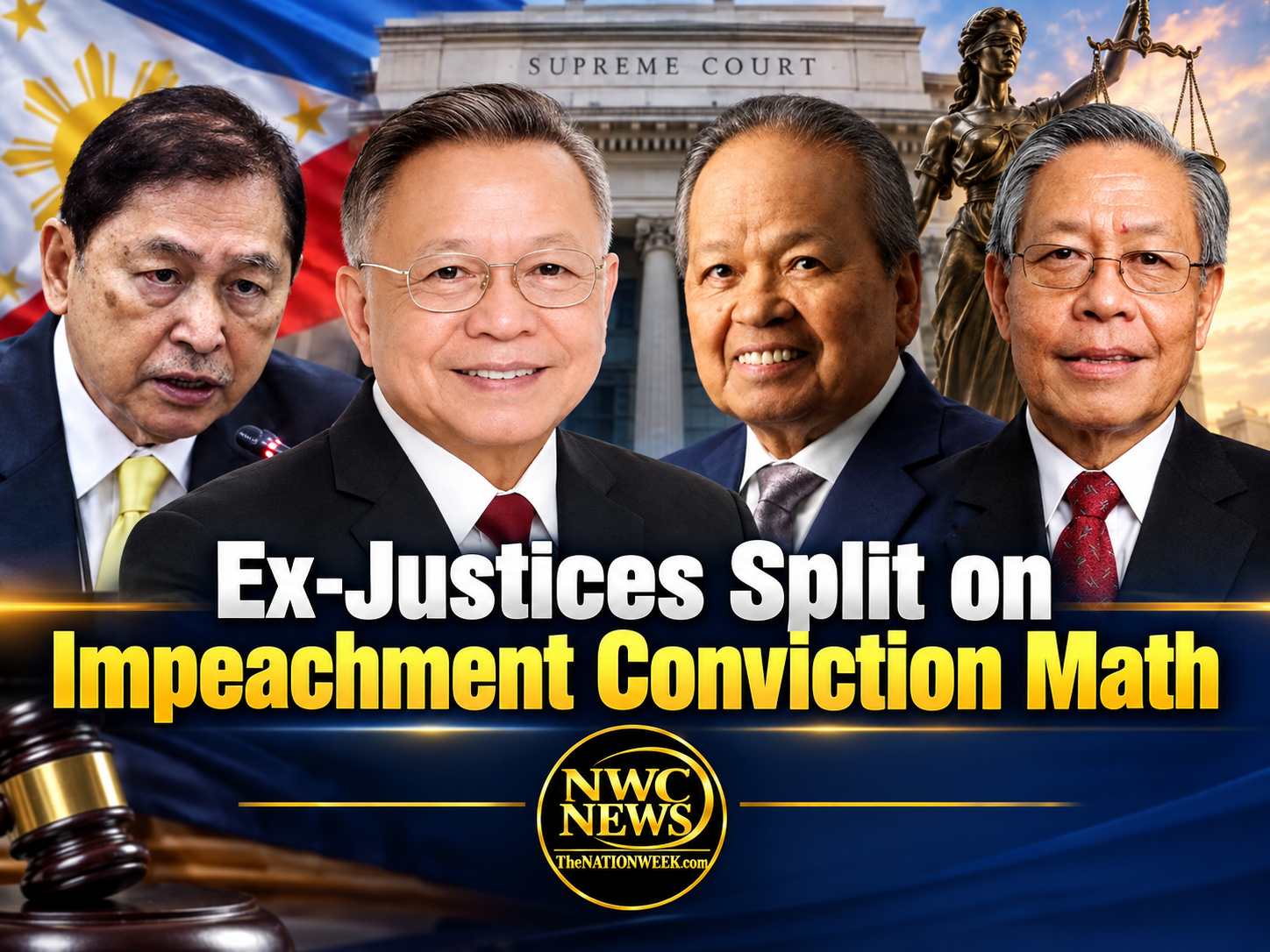
Ex-Justices Split on Impeachment Conviction Math

Ex-Justices Split on Impeachment Conviction Math

Ex-Justices Split on Impeachment Conviction Math

By TheNATIONWEEK.com News Desk | September 17, 2026

MANILA, Philippines – A rare convergence of legal titans has ignited a critical constitutional debate, revealing divergent interpretations of the numerical threshold required for the conviction of an impeachable official. Four esteemed former Philippine Supreme Court justices, acting as “amici curiae,” have dissected the constitutional provision demanding “two-thirds of all the Members of the Senate,” exposing a fundamental schism that could redefine the mechanics of impeachment in the Philippines.

At the heart of the contention lies the question: Is “16 votes” a rigid figure, or can the denominator of “all the Members of the Senate” be interpreted to reflect the operational realities of the chamber? Their insights highlight not only the textual complexities but also the profound practical and philosophical implications for democratic accountability.

The Fractured Interpretations: A Deeper Dive

Chief Justice Hilario Davide Jr.: The Fluid Denominator and the Peril of Absurdity

Former Chief Justice Hilario Davide Jr. champions a flexible interpretation, asserting that the two-thirds requirement must be calculated based on senators legally and physically qualified to participate and vote. He rejects a fixed “16 votes” as absolute, arguing that while the fractional requirement (two-thirds) remains constant, the actual number of senators comprising the “denominator” can and should fluctuate. Davide invokes the precedent of Avelino v. Cuenco, which recognized circumstances that could temporarily impair a senator’s ability to fulfill their functions. His warning: a rigid interpretation that includes incapacitated senators in the voting denominator leads to “absurd or unjust outcomes,” nullifying the intent of counting those unable to perform their duties. This stance fundamentally questions the legitimacy of including non-participating members in a critical constitutional calculation.

Chief Justice Artemio Panganiban: Prioritizing “Reality” and Meaningful Adjudication

Chief Justice Artemio Panganiban pivots the debate from abstract arithmetic to the imperative of “reality” and meaningful adjudication.While conceding that two-thirds of 24 is arithmetically 16, he argues that actual circumstances must alter the denominator. Panganiban interrogates the legitimacy of a judgment rendered by senators who have not actively participated in proceedings, heard evidence, or genuinely engaged in the “search for truth.” For Panganiban, impeachment is an exercise in profound justice, necessitating active, informed participation to uphold the values of truth, fairness, and diligent engagement with the presented evidence. His perspective elevates the process of judgment over a mere numerical outcome.

Chief Justice Reynato Puno: Safeguarding Senate Primacy and Limiting Judicial Overreach

Chief Justice Reynato Puno’s analysis anchors on the ‘institutional authority of the Senate.’ He underscores that the Constitution grants the Senate the “sole power” to try and decide impeachment cases, endowing the impeachment court with primary responsibility for resolving its own procedural questions. Consequently, Supreme Court review is not an opportunity for judicial substitution of judgment but a narrowly defined intervention reserved for instances of “grave abuse of discretion.” Puno reiterates that the Constitution’s phrasing – “two-thirds of all the Members of the Senate” – is distinct from a simple “16 votes,” reinforcing the Senate’s constitutional mandate to interpret and apply this provision within its deliberative framework.

Justice Adolfo Azcuna: The Unwavering Principle of “ALL MEANS ALL”

In contrast, Justice Adolfo Azcuna firmly asserts the principle of “ALL MEANS ALL.” He maintains that the phrase “all the Members of the Senate” was chosen by the framers to guarantee the “arduous nature” of impeachment. This supermajority requirement, demanding two-thirds of all 24 senators (a non-negotiable 16 votes), serves as a safeguard against impeachment being weaponized or diluted by temporary political factions. For Azcuna, the denominator remains inflexible; a senator is part of “all the Members” unless a permanent, constitutionally recognized change in status occurs – such as death, resignation, or removal from office. His interpretation prioritizes textual fidelity and the high bar set for conviction.

The Profound Constitutional Dilemma: An Unspoken Gravity

The collective insights from these eminent legal minds illuminate a profound constitutional dilemma. While Justice Azcuna presents a textually robust, rigid interpretation, the combined reasoning of Justices Davide, Panganiban, and Puno offers significant interpretative latitude, empowering the Senate impeachment court to contextualize the constitutional requirement based on real-world scenarios. Their arguments—focusing on the legal and physical capacity of senators, the reality of meaningful participation, and the Senate’s constitutional power—suggest a more dynamic interpretation of the “two-thirds” threshold.

The potential for absurd outcomes under a strictly rigid interpretation, highlighted by a hypothetical scenario where only 15 senators are able to function, poses a critical question for Philippine jurisprudence: Should the foundational document be interpreted in a manner that renders a vital constitutional power inoperable under extraordinary circumstances?

This exploration into constitutional nuances underscores the delicate balance between strict textual fidelity and the practical exigencies of governance. The challenge is not merely to interpret the Constitution for current realities but for unforeseen eventualities, ensuring its provisions remain effective, prevent the nullification of constitutional powers, and uphold the integrity of the nation’s highest legislative and judicial processes. The debate’s outcome will cast a long shadow over the future of accountability for high-ranking officials in the Philippines.

Leave a Reply

Back To Top