Monday, November 23, 2026 - 10:47 AM
Subscribe/Login
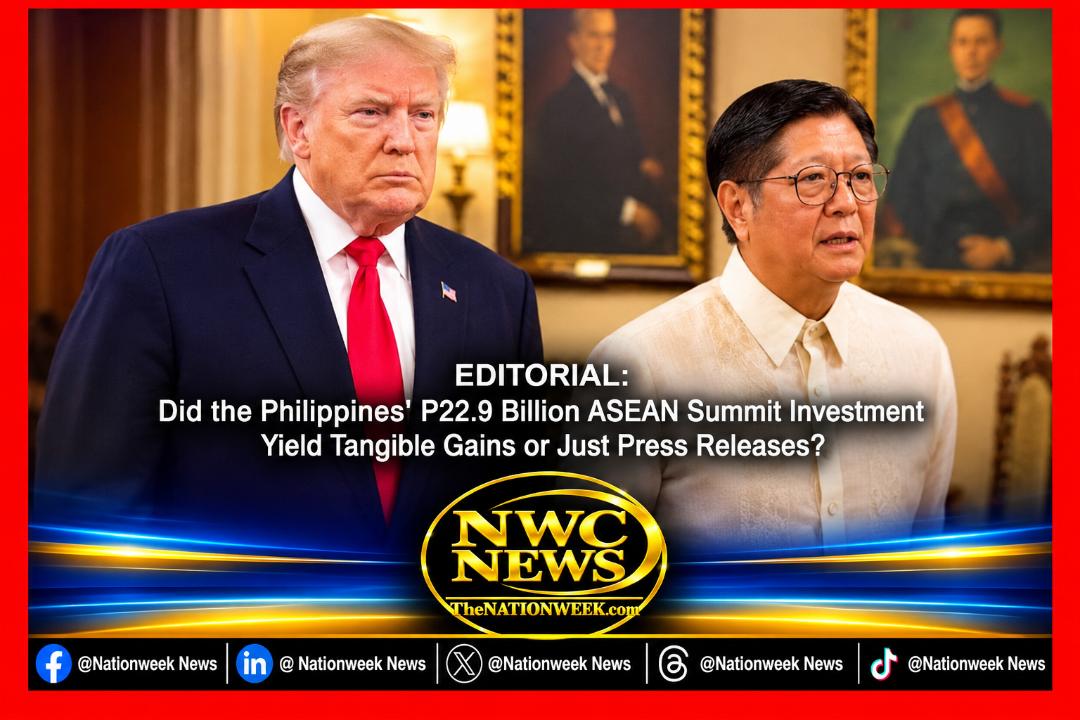
EDITORIAL:  Did the Philippines’ P22.9 Billion ASEAN Summit Investment Yield Tangible Gains or Just Press Releases?

EDITORIAL:  Did the Philippines’ P22.9 Billion ASEAN Summit Investment Yield Tangible Gains or Just Press Releases?

EDITORIAL:  Did the Philippines’ P22.9 Billion ASEAN Summit Investment Yield Tangible Gains or Just Press Releases?

By NATIONWEEK EDITORIAL | November 23, 2026

MANILA, Philippines – As the dust settles on the 49th ASEAN Summit, the Philippine government’s expenditure of P22.9 billion is facing intense public scrutiny.

Filipinos are questioning the tangible benefits derived from this significant investment, particularly amid President Ferdinand R. Marcos Jr.’s recent announcement of securing wider access to American agricultural and energy supplies following discussions with US President Donald Trump.

While official statements highlight potential reductions in food and energy costs for households, a deeper dive reveals a disconnect between projected gains and the persistent struggles of local agricultural sectors.

The Paradox of Agricultural Abundance Amidst Import Dependence

The Philippines, an inherently agricultural nation, paradoxically grapples with heavy reliance on imported staples such as rice, garlic, onions, carrots, and frozen meats. This dependence persists despite the potential for self-sufficiency, a reality underscored by the struggles of local farmers.

Many agricultural producers face an uphill battle to sell their harvests at fair prices, with significant portions often going to waste due to market gluts and insufficient government support.

This lack of strategic intervention leaves farmers vulnerable, often barely recouping their investments and perpetuating a cycle of abject poverty.

Critics argue that robust government support for local farmers – encompassing fair pricing mechanisms, enhanced post-harvest facilities, and direct market access – could transform the Philippines into a self-reliant agricultural powerhouse.

Instead, the persistent preference for imports fuels suspicions of systemic corruption, where lucrative import deals may supersede national food security and the welfare of domestic producers.

The perception of government officials acting as “kleptocrats” and “kakistocrats” who prioritize personal gain over national interest is gaining traction among a disillusioned populace.

Furthermore, valuable agricultural lands are increasingly being converted into commercial subdivisions, further eroding the nation’s capacity for food production.

While some farmers rent arable land, the meager incomes derived often condemn them to perpetual hardship, hindering the very agricultural growth the nation needs.

PBBM’s US Engagement: A Double-Edged Sword for Filipinos?

President Marcos, addressing Philippine media in Shenzhen, China, following the APEC Summit on November 20, declared that an agreement to open US markets to the Philippines would provide the country with more options for essential commodities at competitive prices.

He emphasized that these discussions with President Trump aimed to address inflation and bolster the nation’s food and energy security.

“The agri products in the United States have been highly, highly regulated. Dati ang hirap pumasok sa merkado nila. (Before, it was difficult to enter their market.) Now that has been made available to us,” President Marcos stated, highlighting the perceived breakthrough in market access for American agricultural goods.

He further elaborated that securing more affordable sources of food and energy was a central objective of his meeting with Trump, specifically mentioning soybeans, wheat, and increased rice purchases from the United States.

While the President’s pronouncements offer a glimmer of hope for lower consumer prices, they also raise critical questions about the long-term implications for the Philippines’ agricultural independence.

Is increasing reliance on foreign imports a sustainable solution to inflation, or does it merely perpetuate a cycle of external dependence while local farmers continue to languish?

President Marcos reiterated the importance of diversifying partnerships to build resilience against external economic shocks, stating, “If you’re standing on one foot, sa isa ka lang umaasa, madaling magkaproblema. Pag marami kang naaasahan, kahit magkaproblema ang isa, puwede ka pang tumakbo doon sa mga iba.” (“If you’re standing on one foot, you’re relying on just one thing, which can easily lead to problems. When you have multiple things to rely on, even if one encounters an issue, you can still turn to the others.”)

While this strategy aims to reduce vulnerability, it must be balanced with a robust national strategy to empower domestic production and protect local livelihoods.

The P22.9 Billion Question: Investments or Illusions?

The public’s skepticism surrounding the P22.9 billion ASEAN Summit expenditure stems from a perceived lack of concrete foreign investments beyond the official press releases.

Many Filipinos feel that the substantial outlay has not translated into tangible economic benefits that trickle down to the average citizen, particularly when juxtaposed with the ongoing struggles of key sectors.

As Cabinet Secretaries reportedly begin working on the details of the tariff track, the nation watches intently. The true measure of the 49th ASEAN Summit’s success, and indeed President Marcos’s recent diplomatic engagements, will not lie in the magnitude of spending or the promise of future deals.

It will be found in the sustained reduction of food and energy costs for ordinary Filipinos, the empowerment of local farmers, and the genuine strengthening of the Philippines’ economic resilience – not just through imports, but through a revitalized domestic production that champions self-reliance and equitable growth.

[Note: AI technology was used to generate the thumbnail.]

*          *          *

Your support fuels independent and fearless journalism.

To advertise with us, please contact us today at: nationweek@yahoo.com.

You can also make a donation via GCash at: +639267015155.

Follow Us On Social Media

Leave a Reply

Back To Top