Tuesday, November 24, 2026 - 11:31 AM
Subscribe/Login
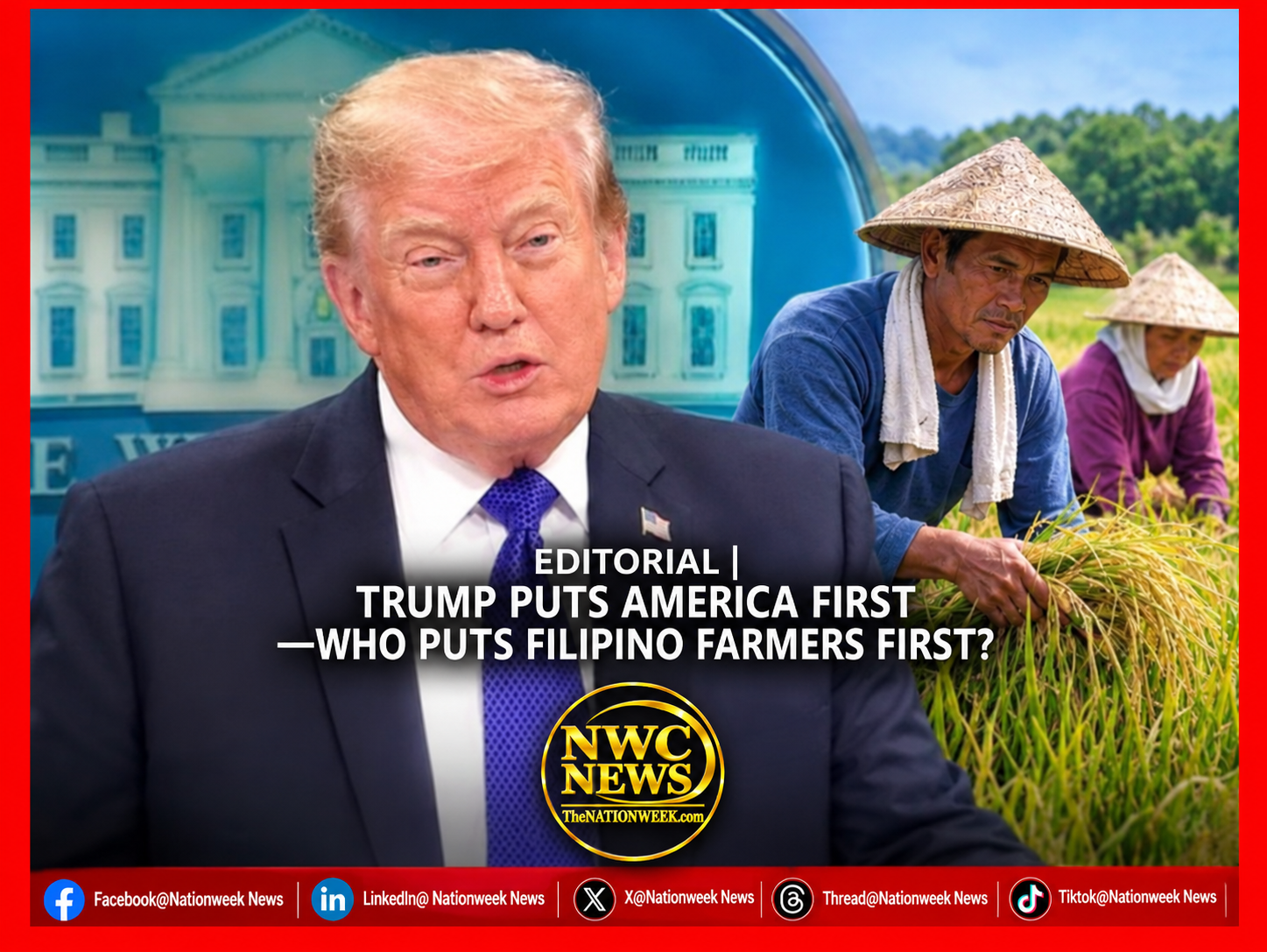
EDITORIAL | TRUMP PUTS AMERICA FIRST—WHO PUTS FILIPINO FARMERS FIRST?

EDITORIAL | TRUMP PUTS AMERICA FIRST—WHO PUTS FILIPINO FARMERS FIRST?

EDITORIAL | TRUMP PUTS AMERICA FIRST—WHO PUTS FILIPINO FARMERS FIRST?

THE GREAT BETRAYAL: A NATION THAT FEEDS ITS PEOPLE BUT ALLOWS ITS FARMERS TO GO HUNGRY

By NATIONWEEK EDITORIAL | November 24, 2026

MANILA, Philippines — President Donald Trump’s America First doctrine offers a revealing lesson in economic nationalism: a government must aggressively defend its industries, workers, businesses and national interests. Washington negotiates billions in commercial agreements, secures markets for American products and pursues opportunities for American industries. It does so without apology.

But in the Philippines, a far more fundamental question remains unanswered: If America puts American farmers first, who puts Filipino farmers first?

While Washington fights for its agricultural producers, millions of Filipino farmers remain trapped in poverty, burdened by expensive production inputs, insecure land tenure, inadequate irrigation, limited financing, exploitative market conditions and government policies that have repeatedly failed to deliver meaningful agricultural transformation.

The contradiction is indefensible. The people who feed the nation remain among its poorest. The country celebrates international investment while its own agricultural foundation continues to weaken.

This is not simply an agricultural crisis. It is a failure of economic leadership, social justice and national responsibility.

BILLIONS FOR AMERICA, BUT WHAT FOR THE FILIPINO PEOPLE?

During his November 17–18 visit to Manila, Trump promoted more than US$17 billion in commercial deals and strategic investment initiatives across Southeast Asia. The White House presented these arrangements as opportunities for American businesses, workers, exporters and industries.

Among the largest was a US$12-billion commercial agreement involving Boeing, GE Aerospace and Philippine Airlines for up to 20 Boeing 787 aircraft, with the White House projecting support for approximately 47,000 American jobs.

Other announced initiatives included proposed Foreign Military Financing exceeding US$2 billion for Philippine defense purchases, US$37 million in defense technology contracts, a US$63-million defense cloud modernization project, satellite connectivity potentially valued at US$200 million, civil nuclear cooperation and infrastructure projects involving Subic Bay and Basco Airport.

These agreements may advance legitimate Philippine interests in national defense, technology, connectivity and infrastructure. But their economic value must be examined beyond diplomatic ceremonies and headline figures.

The aircraft agreement is a commercial transaction, not a US$12-billion Philippine government grant. Proposed defense financing is not an immediate cash transfer, and projected American employment figures are estimates rather than confirmed jobs already created.

More importantly, Washington has identified increased Philippine purchases of American energy and agricultural products as part of its effort to address the US trade deficit.

That is entirely consistent with Trump’s America First agenda. American farmers and businesses are expected to benefit from expanded access to Philippine markets.

But where is the equivalent commitment to protect Filipino producers?

What safeguards will prevent increased agricultural imports from further undermining domestic farmers? What investments will strengthen local production? What concrete benefits will reach rural communities?

A country cannot measure economic success by the volume of foreign purchases while ignoring the deterioration of its domestic productive capacity.

AMERICA PROTECTS ITS ECONOMIC INTERESTS. WHY DOES MANILA FAIL TO PROTECT ITS FARMERS?

The regional agreements promoted during Trump’s diplomatic offensive reinforce Washington’s determination to convert international partnerships into commercial and strategic advantages.

Thailand advanced a trade arrangement providing for the elimination of tariffs on 99 percent of goods, subject to domestic implementation, while announcing plans to purchase up to US$123 million in American HIMARS rocket systems.

Indonesia entered negotiations involving a proposed US$2-billion coal development project with American company Latitude Energy and sovereign wealth fund Danantara. Malaysia was associated with a US$100-million coal supply agreement involving Navajo Transitional Energy Company, alongside opportunities in artificial intelligence infrastructure. Brunei announced a proposed data-center development potentially involving nearly US$1 billion in American-sourced spending.

Not every announced transaction represents completed investment. Nevertheless, the direction is unmistakable: Washington is mobilizing trade, technology, defense and investment to advance American interests.

There is nothing objectionable about that. Protecting domestic industries is a legitimate responsibility of government.

The real scandal is the Philippines’ persistent failure to demonstrate comparable determination toward its own agricultural producers.

Why should American farmers enjoy a government actively pursuing market opportunities while Filipino farmers struggle for affordable fertilizer, reliable irrigation, accessible credit and fair prices?

Why should foreign commercial interests receive elaborate negotiating frameworks while rural communities continue waiting for basic infrastructure?

And why should the country expand trade without ensuring that its domestic producers have the resources and protections necessary to compete?

THE PEOPLE WHO FEED THE NATION ARE AMONG ITS POOREST

The human consequences of agricultural neglect are devastating.

Philippine Statistics Authority figures place the average daily basic pay of wage-and-salaried agricultural workers at approximately ₱350.18 in 2024. IBON Foundation estimated that a family of five needed approximately ₱1,277 daily to meet its living requirements in July 2026.

These figures measure different things and should not be treated as directly comparable household-income statistics. Nevertheless, they illustrate the financial hardship confronting low-paid agricultural workers.

Smallholder farmers face an even more precarious economic reality. They have no guaranteed daily income, paid leave or assurance of a profitable harvest. Their earnings depend on weather conditions, production expenses, market prices and the bargaining power of traders.

They borrow to plant, spend months cultivating their land and shoulder the risks of production, only to discover that their harvest may not cover their expenses.

A poor harvest can destroy a family’s finances. Even a productive harvest can become a financial loss when farmgate prices collapse.

The poverty figures expose the structural injustice: poverty incidence among farmers reached 27 percent in 2023, compared with 15.5 percent nationally.

This is an indictment of a development model that depends on agricultural labor without adequately rewarding it.

How can a nation claim progress when those who produce its food cannot reliably feed their own families?

SHRINKING FARMLANDS, GROWING IMPORT DEPENDENCE

The country’s agricultural vulnerability is compounded by the erosion of its productive land base.

The 2022 Census of Agriculture and Fisheries recorded approximately 7.73 million farms covering 6.31 million hectares, down from 9.97 million hectares in 1991.

Land conversion, fragmentation, insecure tenure and unresolved agrarian reform issues continue to undermine agricultural productivity. Many farmers lack the land security, capital, technology and infrastructure necessary to modernize their operations.

Meanwhile, the Philippines remains heavily dependent on imported agricultural commodities.

In 2025, agricultural imports reached approximately US$20.37 billion, against exports of US$9.25 billion, producing a trade deficit of US$11.12 billion.

Rice self-sufficiency improved to 78.1 percent in 2025 from 71.7 percent in 2024. That improvement is welcome, but it does not eliminate the country’s dependence on foreign supply.

Imports can help address shortages and stabilize consumer prices. International trade is necessary. But imports must complement domestic production, not become a permanent substitute for agricultural development.

The Rice Tariffication Law of 2019 intensified the debate over liberalized rice imports and the competitiveness of local producers. Its implementation must be judged against a fundamental question: have Filipino farmers become more productive, financially secure and economically competitive?

If the answer remains inadequate, government must confront the shortcomings of its policies rather than expect farmers to absorb the consequences.

Food security cannot depend indefinitely on imports while the country’s own capacity to produce food remains neglected.

THE PROFIT GAP: FARMERS PRODUCE, OTHERS CONTROL THE MARKET

One of Philippine agriculture’s most persistent injustices is the imbalance of economic power between producers and the commercial networks controlling distribution.

Farmers frequently lack cold storage, processing facilities, transportation, market information and direct access to institutional buyers. Perishable produce must be sold quickly, leaving small producers vulnerable to unfavorable buying prices.

Consumers, meanwhile, often pay substantially more at retail markets than farmers receive at the farmgate.

This disparity demands serious investigation.

Who determines farmgate prices? Who controls distribution channels? Why do producers repeatedly report depressed buying prices while consumers face expensive food? Are intermediaries exploiting weak competition, inadequate regulation or farmers’ lack of alternatives?

These questions require transparent pricing systems, independent market investigations and effective enforcement—not another round of political assurances.

Government must strengthen agricultural cooperatives, develop farm-to-market infrastructure, expand local processing, establish accessible storage facilities and connect producers directly with institutional buyers.

Where evidence establishes price manipulation, anti-competitive conduct or abusive trading practices, authorities must investigate and prosecute those responsible.

Farmers must not remain the weakest and most exploited participants in a supply chain that cannot function without them.

FOREIGN INVESTMENT MUST SERVE THE NATIONAL INTEREST

The Philippines needs foreign investment, technology, infrastructure and international partnerships. But economic openness must never become an excuse for weakening domestic industries, compromising community rights or disregarding national food security.

Republic Act No. 12252, enacted in 2025, permits qualified foreign investors to lease private land for periods of up to 99 years under specified conditions. It does not authorize foreign ownership of Philippine land.

Nevertheless, such long-term arrangements require rigorous safeguards to protect land-use regulations, environmental standards, legitimate community interests and agricultural priorities.

Development cannot mean that rural communities shoulder the risks while powerful commercial interests capture the rewards.

The same principle must govern trade agreements. Expanded access for foreign agricultural products must be accompanied by credible assessments of their effects on domestic producers and concrete programs to strengthen local competitiveness.

Agriculture must cease to be treated as a peripheral sector sustained by occasional subsidies and politically convenient assistance.

It is a strategic national industry, inseparable from food security, economic independence, employment and sovereignty.

THE MARCOS ADMINISTRATION MUST ANSWER FOR AGRICULTURAL NEGLECT

The Marcos administration cannot equate economic progress with foreign investment announcements, diplomatic agreements and projected commercial figures.

It must demonstrate what those achievements mean for ordinary Filipinos—and, above all, for the people who produce the country’s food.

Where is the comprehensive program guaranteeing affordable fertilizers, seeds, fuel and other farm inputs?

Where are the dependable irrigation systems, modern postharvest facilities, accessible agricultural financing and functioning farm-to-market networks?

Where is the mechanism ensuring fair farmgate prices and protecting farmers from abusive trading practices?

Where is the measurable commitment to protect agricultural land, resolve land-tenure disputes, strengthen cooperatives and raise rural incomes?

These are not peripheral demands. They are the foundations of food security and national economic resilience.

The government must establish measurable agricultural targets, disclose public expenditures, publish implementation results and hold responsible officials accountable for persistent failures.

The Department of Agriculture must be judged not by announcements, ceremonial distributions or the number of beneficiaries appearing in official photographs, but by measurable improvements in farmers’ productivity, earnings, land security and living conditions.

Public assistance must reach legitimate beneficiaries without political favoritism, corruption or waste. Agricultural financing must be accessible rather than burdened by prohibitive requirements. Infrastructure must respond to actual production needs, not merely political priorities.

Most importantly, the government must confront the structural causes of rural poverty: unequal access to productive land, expensive inputs, inadequate infrastructure, weak bargaining power, limited financing and inconsistent agricultural policy.

Farmers do not need another publicity campaign. They need an agricultural system that allows them to prosper.

A NATION CANNOT EAT DIPLOMATIC ANNOUNCEMENTS

The Philippines must pursue international partnerships, but it must negotiate from a position of national purpose and economic responsibility.

Foreign investment is beneficial when it generates decent employment, transfers technology, strengthens local industries and respects Philippine laws. Trade is valuable when it expands opportunities without destroying domestic productive capacity. Defense cooperation matters when it strengthens national security and protects sovereignty.

But none of these can substitute for a functioning agricultural economy.

A nation cannot indefinitely depend on foreign suppliers while neglecting its own food producers. It cannot celebrate market access for foreign exporters while leaving Filipino farmers without the capital, technology and infrastructure to compete.

Nor can it credibly claim inclusive economic growth while rural poverty remains entrenched.

The true measure of government performance is not how warmly foreign leaders receive Philippine officials or how many billions appear in diplomatic announcements.

It is whether ordinary Filipinos experience tangible improvements in their lives.

For farmers, progress means secure land, affordable production inputs, dependable irrigation, accessible financing, fair farmgate prices, functioning markets and a dignified return for their labor.

Anything less is another broken promise.

THE FINAL VERDICT: PUT FILIPINO FARMERS FIRST

Trump’s America First policy offers a straightforward lesson: nations that take their economic interests seriously defend their domestic industries with determination.

The Philippines must demonstrate the same resolve.

The betrayal of Filipino farmers did not begin with Trump’s visit, nor can it be attributed to a single foreign agreement. It is the accumulated consequence of decades of inadequate agricultural investment, unresolved land issues, inconsistent policies, weak market protections and political leadership that has too often treated farmers as recipients of temporary assistance rather than indispensable partners in national development.

Responsibility rests with Philippine institutions and successive administrations that have failed to make agricultural prosperity a sustained national priority.

The farmers who plant rice, cultivate vegetables, raise livestock and work the land are not asking for charity. They are demanding the economic conditions necessary to earn a decent living from their labor.

They deserve more than campaign promises, ceremonial assistance and temporary relief. They deserve a government prepared to defend their livelihoods with the same determination

Washington demonstrates in defending American commercial interests.

The Marcos administration must therefore answer a question more consequential than the value of any foreign investment agreement:

What concrete benefits will its economic partnerships deliver to Filipino farmers, and what is the government’s measurable commitment to ending their generational poverty?

The country cannot achieve economic independence by abandoning the people who produce its food. It cannot claim food security while its farmers remain impoverished. And it cannot call development inclusive when those sustaining the nation’s food supply are excluded from its economic gains.

America First is Washington’s declared national priority.

The Philippines must finally make Filipino farmers its own.

A government that aggressively pursues foreign commercial opportunities while neglecting its domestic food producers is not building lasting prosperity. It is weakening the very agricultural foundation upon which national security, economic independence and the country’s future depend.

THE QUESTION IS NO LONGER WHETHER AMERICA WILL PUT AMERICA FIRST. IT IS WHETHER THE PHILIPPINES WILL FINALLY PUT FILIPINO FARMERS FIRST.

[Note: AI technology was used to generate the thumbnail.]

*          *          *

Your support fuels independent and fearless journalism.

To advertise with us, please contact us today at: nationweek@yahoo.com.

You can also make a donation via GCash at: +639267015155.

Follow Us On Social Media

Leave a Reply

Back To Top