Tuesday, September 22, 2026 - 02:15 PM
Subscribe/Login
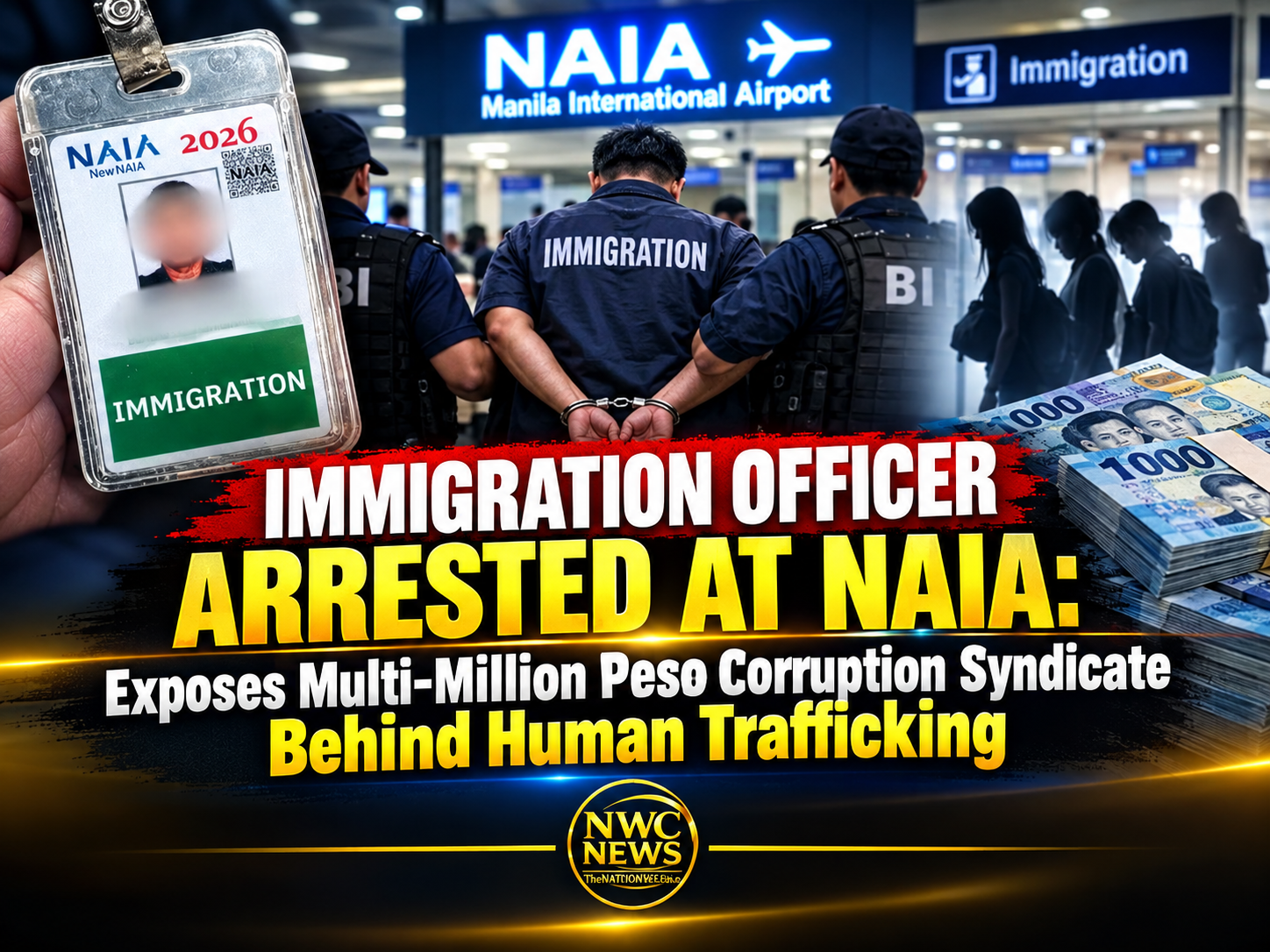
Immigration Officer Arrested at NAIA: Exposes Multi-Million Peso Corruption Syndicate Behind Human Trafficking

Immigration Officer Arrested at NAIA: Exposes Multi-Million Peso Corruption Syndicate Behind Human Trafficking

Immigration Officer Arrested at NAIA: Exposes Multi-Million Peso Corruption Syndicate Behind Human Trafficking

By Bing Jabadan – TheNATIONWEEK.com | September 22, 2026

MANILA, Philippines – The recent arrest of an immigration officer at Ninoy Aquino International Airport (NAIA) Terminal 1 for allegedly facilitating human trafficking reveals not an isolated incident but the pervasive reality of a deeply entrenched corruption syndicate. This network generates millions daily, compromising national security and preying on vulnerable individuals.

The National Bureau of Investigation (NBI) apprehended the immigration officer following a September 12 incident involving a suspected trafficking victim. This passenger, arriving 12 hours before her scheduled flight, was processed for departure nine hours early—a red flag indicating systemic circumvention of protocol. While the Bureau of Immigration (BI) has announced the relief of personnel, evidence from ongoing hearings and internal investigations points to a meticulously organized scheme far exceeding a few rogue employees.

This operation represents a resurgence of the notorious “pastillas” scheme, where illicit payments are exchanged for expedited, unscrutinized entry and exit. Testimony before the Sandiganbayan reveals that facilitators collected a substantial amount per trafficked individual, with high-level operatives commanding up to ₱10,000 per traveler—primarily Chinese nationals bypassing mandatory profiling and vetting. Whistleblower Allison Chiong, a former immigration official, confirmed at least 143 passengers processed through irregular channels in a single batch. Payments, coordinated via encrypted group chats, often included instructions referencing “GC,” believed to denote higher-ranking figures. Previous testimony implicated former officials Dennis Robles, Erwin Ortañez, and Anthony Lopez as key orchestrators.

The persistence of this illicit network is alarming. First exposed in 2020 amid an unprecedented surge in Chinese arrivals, the “pastillas” racket was never fully dismantled. Instead, it adapted, shifting routes and communication methods, embedding itself deeper into daily airport operations. Today, this infrastructure facilitates not only unauthorized entry but also human trafficking and illegal recruitment. Days after the Terminal 1 arrest, BI agents intercepted four Filipinos at NAIA en route to Russia, recruited online with promises of substantial monthly pay (₱70,000-₱150,000), some for military service, traveling on falsified itineraries listing Thailand and Vietnam. These are not disparate events but facets of the same criminal enterprise exploiting critical border vulnerabilities.

BI Commissioner Joel Anthony M. Viado has announced the deployment of body-worn cameras for airport officers by the end of October, vowing stringent action. However, such measures may not address collusion across shifts, off-the-record arrangements, or the protection of errant personnel by supervisors. Investigators now acknowledge that the clearance process extends beyond a single immigration counter, implicating personnel across multiple units and potentially external stakeholders from terminal entry to final departure. Critical questions remain unanswered: Who coordinated the passenger’s early access? Who escorted her through checkpoints? Who authorized early clearance?

The Terminal 1 arrest is not a testament to reform but a stark reminder of deep-seated corruption. The “pastillas” network did not vanish; it evolved. The focus on frontline arrests risks shielding the architects, financiers, and political protectors who sustain this trade, whose lavish lifestyles are funded by exploiting the nation’s borders.

Unless the inquiry transcends low-level arrests to target the command structure, financial backers, and political enablers, another scandal is inevitable. What has been uncovered is merely the visible layer of a fully operational corruption industry that treats the Philippines’ borders as a lucrative marketplace and national security as a commodity for sale.

Leave a Reply

Back To Top