Tuesday, September 29, 2026 - 05:53 AM
Subscribe/Login
“Duterte Release Looms Amid U.S. Sanctions on ICC”

“Duterte Release Looms Amid U.S. Sanctions on ICC”

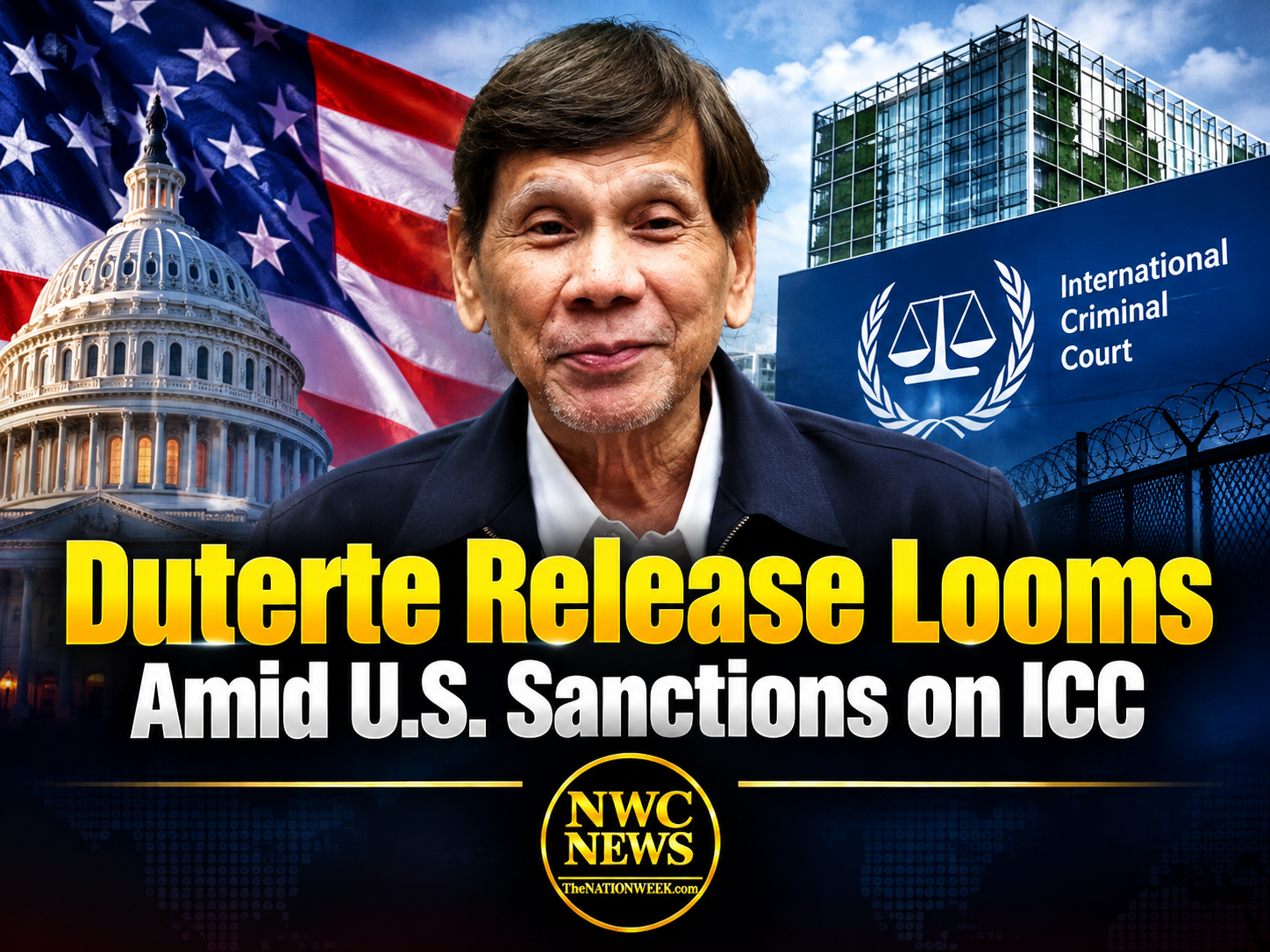
Former Philippine President Rodrigo Duterte appears at the International Criminal Court (ICC) in The Hague on September 16, 2026, during a preparatory session as he faces charges over his “war on drugs.”

“Duterte Release Looms Amid U.S. Sanctions on ICC”

By Bing Jabadan – TheNATIONWEEK.com | September 28, 2026

MANILA, Philippines – The International Criminal Court (ICC) faces an existential crisis as the U.S. government, under President Donald Trump’s administration, reportedly prepares an unprecedented package of sanctions targeting the institution itself. 

This dramatic escalation, following previous measures against individual court officials, could effectively cripple the ICC, leading to the potential release of individuals charged with or convicted of severe atrocities, including former Philippine President Rodrigo Duterte.

Sources indicate the sanctions, aiming to “dismantle the ICC—brick by brick,” would prohibit most transactions with the Court after a six-to-seven-month grace period. Should this effort succeed in undermining the ICC’s operational capacity, the consequences for ongoing cases and the continued detention of individuals accused of war crimes and crimes against humanity would be profound. Detainees awaiting trial, judgment, or the outcome of appeals could argue for their release if the Court becomes unable to function or provide effective legal processes.

Among those currently in ICC custody whose fate hangs in the balance are:

Rodrigo Roa Duterte (Philippines): The former President (2016–2022) and long-time Davao City mayor, allegedly linked to the Davao Death Squad.

Crimes

On April 23, 2026, a Pre-Trial Chamber unanimously confirmed three counts of crimes against humanity, specifically murder and attempted murder. The charges detail at least 76 alleged murders and two attempted murders, including those of children, during anti-crime campaigns in Davao City and across the Philippines between 2013 and 2018.

Status

In ICC custody; trial set for November 30, 2026.

Khaled Mohamed Ali El Hishri (Libya): 

An alleged former senior official of Libya’s Special Deterrence Force and Mitiga Prison.

Crimes

On July 16, 2026, a Pre-Trial Chamber unanimously confirmed 17 counts of crimes against humanity and war crimes. These include murder, attempted murder, sexual violence, torture, enslavement, imprisonment, outrages upon personal dignity, and persecution, affecting thousands of detainees at Mitiga Prison and other Tripoli locations from May 2014 to June 2020.

Status:

In ICC custody; trial set for May 4, 2027.

Mahamat Said Abdel Kani (Central African Republic): 

A former Seleka commander who headed the Central Office for the Repression of Banditry (OCRB).

Crimes

On September 23, 2026, a Trial Chamber unanimously convicted Said of four counts of crimes against humanity: imprisonment, torture, other inhumane acts, and persecution. These crimes were committed at the OCRB between April and August 2013, targeting perceived supporters of former President François Bozizé, including the unlawful imprisonment of at least 39 people and torture of 22.

Status

In ICC custody awaiting sentence.

Alfred Rombhot Yekatom (Central African Republic): 

A former Anti-Balaka commander.

Crimes

On July 24, 2025, a Trial Chamber unanimously convicted Yekatom of 19 counts of war crimes and crimes against humanity, including murder, torture, cruel treatment, imprisonment, persecution, forcible transfer, and attacks on civilians and a mosque, committed between December 2013 and February 2014. These convictions covered killings of Muslim civilians in Bangui, abuse of captives at Yamwara, and forced displacement from PK9 to Mbaïki.

Status

Sentenced to 15 years’ imprisonment on July 24, 2025; in ICC custody pending appeal.

Patrice-Edouard Ngaïssona (Central African Republic): 

A former senior Anti-Balaka organizer.

Crimes

On July 24, 2025, a Trial Chamber convicted Ngaïssona of 27 counts of war crimes and crimes against humanity, including murder, torture, cruel treatment, imprisonment, persecution, forcible transfer, attacks on civilians and a mosque, and destruction of property, committed between December 2013 and April 2014. He was found responsible for aiding and abetting crimes in Bangui, Yamwara, along the road from PK9 to Mbaïki, and in Bossangoa.

Status:

Sentenced to 12 years’ imprisonment on July 24, 2025; in ICC custody pending defense and prosecution appeals.

Ali Muhammad Ali Abd-Al-Rahman (“Ali Kushayb”) (Darfur, Sudan): 

A former commander of the government-allied Janjaweed militia.

Crimes:

On October 6, 2025, a Trial Chamber unanimously convicted Abd-Al-Rahman of 27 counts of war crimes and crimes against humanity. These include murder, attempted murder, rape, torture, persecution, forcible transfer, attacks on civilians, pillaging, and destruction of property, committed between August 2003 and March 2004. He was held responsible for personally committing murder and torture, joint crimes, and ordering crimes including rape, covering attacks on predominantly Fur civilians and the torture and mass execution of detainees.

Status

Sentenced to 20 years’ imprisonment on December 9, 2025; in ICC custody pending appeals against conviction and sentence.

The potential dissolution of the ICC under U.S. pressure represents a critical juncture for international justice, threatening to unravel years of efforts to hold perpetrators of heinous crimes accountable and leaving victims without recourse.

Divergent opinions persist among Filipinos regarding the legal challenges faced by former President Duterte. While a significant portion of the population views him as a victim of politically motivated charges and fabricated accusations, a substantial number believe that the International Criminal Court (ICC) is being exploited by a corrupt elite—characterized by kakistocracy and kleptocracy—to evade accountability for widespread systemic corruption. This alleged corruption, particularly involving fraudulent flood control projects, is believed to have diverted billions into private hands.

The international community observes these high-profile cases closely, along with the evolving credibility of the ICC itself, especially amid unverified allegations of the court accepting substantial monetary inducements. The future implications for both the individuals involved and the institution remain uncertain.

Leave a Reply

Back To Top