Wednesday, November 11, 2026 - 08:25 PM
Subscribe/Login
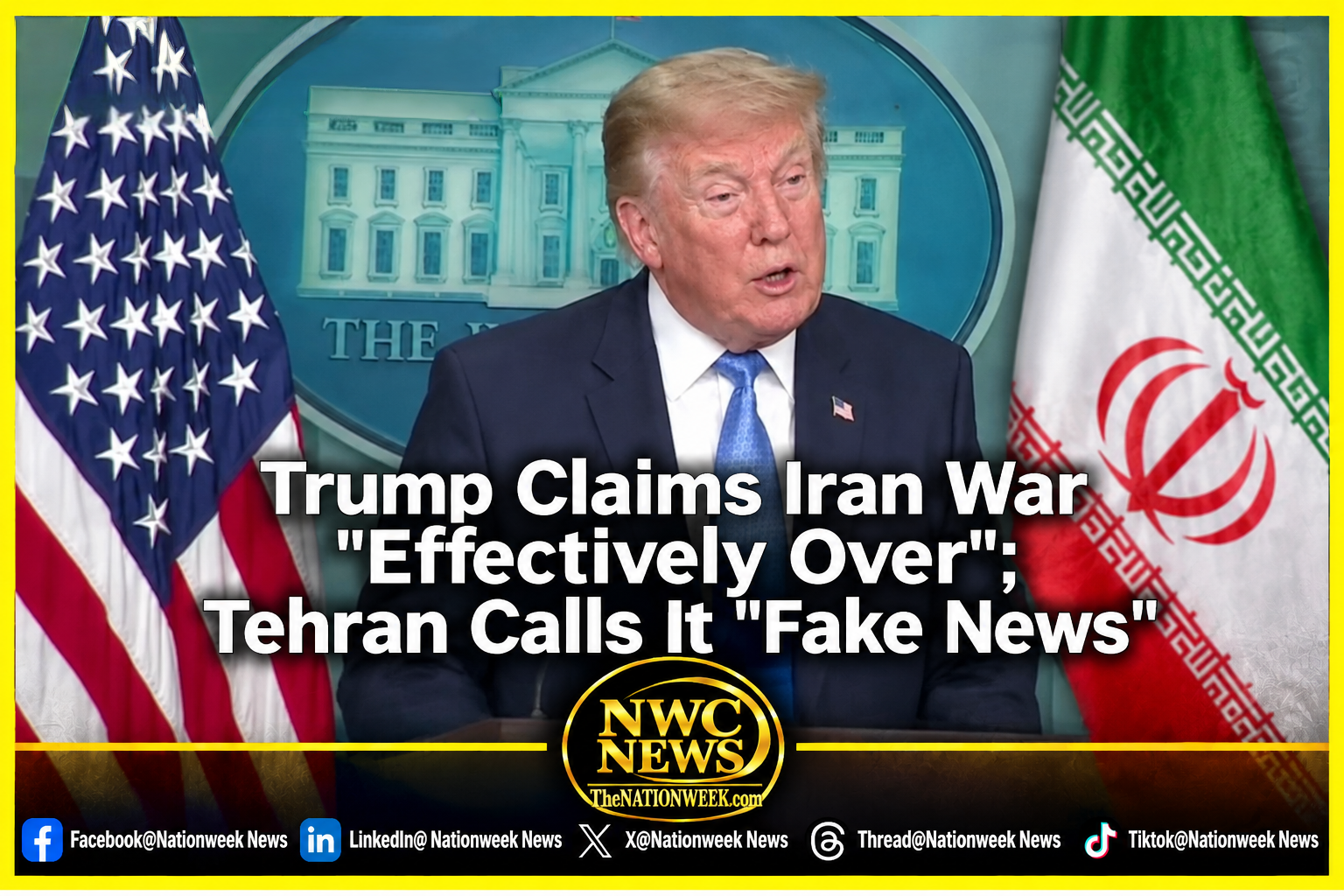
Trump Claims Iran War “Effectively Over”; Tehran Calls It “Fake News”

Trump Claims Iran War “Effectively Over”; Tehran Calls It “Fake News”

Trump Claims Iran War “Effectively Over”; Tehran Calls It “Fake News”

By Paul V. Young – TheNATIONWEEK.com | November 11, 2026

WASHINGTON, D.C. – In a surprising declaration following a meeting with Qatar’s Prime Minister, U.S. President Donald Trump asserted on November 9, 2026, that the U.S.-Israel military conflict with Iran was “effectively over.” Iranian officials swiftly rejected Trump’s assessment, labeling it “fake news” and a desperate maneuver.

Trump, speaking from the White House, reiterated his stance on Iran’s military capacity, suggesting a shift in strategy possibly influenced by regional allies advocating for de-escalation. “Iran militarily is effectively over,” Trump stated, adding, “We’re just keeping it the status quo, and we’re doing that really at the behest of countries that are their neighbors.”

These remarks followed a closed-door discussion with Vice President JD Vance and Qatari Prime Minister Sheikh Mohammed bin Abdulrahman bin Jassim Al Thani. The Qatari Prime Minister publicly acknowledged the positive discussions, stating, “We discussed the situation in the region and ways to progress the U.S.-Iran talks. I am grateful for the positive discussions on reaching a deal and bringing peace to the region.”

Despite Trump’s pronouncement of the war’s military conclusion, he indicated that the “status quo” would entail the continuation of the U.S. naval blockade against Iranian ports and the recently established Task Force Iron Gate, aimed at interdicting trade via land and the Caspian Sea. Trump underscored the regional support for this ongoing pressure: “Qatar, Saudi Arabia, UAE, Bahrain, Kuwait, and others would prefer the status quo, that we remain as is. In other words, a continuation of the greatest naval blockade in the history of our country. Probably in the history of the world.”

The President also maintained the option for renewed aggression, stating, “Taking military action doesn’t seem to be a very necessary thing, but we’re locked and loaded, ready to go for any reason that changes. Israel and the entire Middle East are protected from Iranian danger and threats, and we’re seeing momentum toward the end of this conflict. I think it’s going to be ending fairly soon.”

However, Tehran’s response was immediate and defiant. Mohsen Rezaei, Secretary of Iran’s Supreme National Security Council, characterized Trump’s comments as a desperate gambit: “The war on Iran has already wrecked the U.S. government. But Washington flails like a desperate gambler. FOLD YOUR HAND. STOP manufacturing FAKE NEWS about imaginary talks.”

Separately, Iranian President Masoud Pezeshkian conveyed that Supreme Leader Mojtaba Khamenei had called for an end to the “neither war nor peace” situation. Pezeshkian affirmed Iran’s openness to negotiations but stressed, “We will not surrender to force and bullying.”

The conflict, which commenced on February 28, has profoundly destabilized the region and disrupted global trade. Iran’s immediate response to the initial U.S. and Israeli attacks was to threaten closure of the Strait of Hormuz, a crucial conduit for oil, gas, and fertilizer. Iran also retaliated with missile and drone attacks on Gulf neighbors, frequently targeting U.S. military installations.

Peripheral conflicts have emerged, including renewed fighting between Saudi Arabia and Iran-backed Houthis, and Israel’s occupation of southern Lebanon, alongside deadly airstrikes. The U.S. offensive against Iran has, in recent months, become sporadic, marked by intermittent exchanges of fire. Recent actions include “minor strikes” against Iran’s Qeshm Island and a $20 million reward for information regarding Iran’s nuclear program.

Despite Trump’s earlier claims post-Twelve-Day War in June 2025 that Iran’s uranium enrichment program was “obliterated,” curtailing this program remains a central premise for the ongoing conflict. Iran consistently denies pursuing nuclear weapons, asserting its enrichment program is for civilian energy.

Iranian officials have outlined seven conditions for ending the war, including lifting U.S. sanctions, releasing frozen Iranian funds, recognizing a new shipping route through the Strait of Hormuz negotiated with Oman, and ending all fronts of the war, including Israeli actions in Lebanon.

Qatar has played a critical mediating role, with Prime Minister Sheikh Mohammed bin Abdulrahman bin Jassim Al Thani acting as a key intermediary. During Monday’s closed-door meeting, he reportedly presented Trump with a two-day Iranian proposal to conclude the conflict.

When pressed by reporters on why not simply declare the conflict over, Trump framed the continued U.S. blockade as essential for regional security and emphasized the need for a “long-term solution” to protect allies. “They are right now a lot safer than they were six months ago because Iran’s been very much decapitated. But they’re still the bully of the Middle East a little bit,” he concluded.

*          *          *

Your support fuels independent and fearless journalism.

To advertise with us, please contact us today at: nationweek@yahoo.com.

You can also make a donation via GCash at: +639267015155.

Leave a Reply

Back To Top