Thursday, November 12, 2026 - 08:52 PM
Subscribe/Login
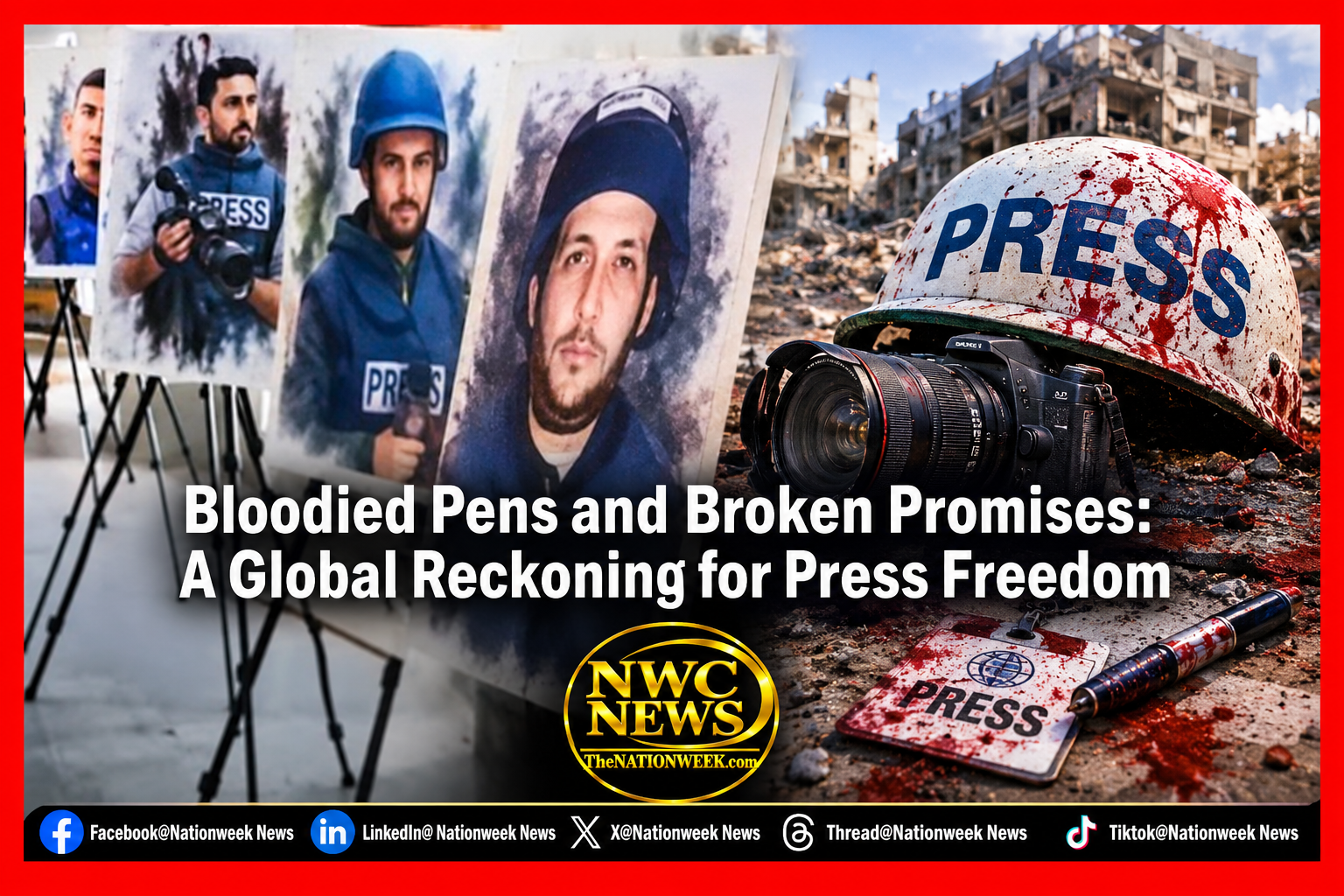
Bloodied Pens and Broken Promises: A Global Reckoning for Press Freedom

Bloodied Pens and Broken Promises: A Global Reckoning for Press Freedom

Bloodied Pens and Broken Promises: A Global Reckoning for Press Freedom

By Bing Jabadan – TheNATIONWEEK.com | November 12, 2026

GAZA | MEXICO – In the shadows of geopolitical conflict and the glare of political transitions, an alarming pattern of violence and unfulfilled promises is suffocating press freedom worldwide. From the relentless bombardments in Gaza to the persistent impunity in Mexico, journalists face existential threats, often with the complicity or inaction of those sworn to protect them.

Based on the data presented by the Committee to Protect Journalists (CPJ) and Reporters Without Borders (RSF), a stark reality emerges: the vast majority of journalists killed in conflict zones are local voices, and the pledges made to safeguard the press are, in many cases, hollow echoes.

Gaza’s Silenced Voices: An Unprecedented Toll

Since October 7, 2023, the conflict in Gaza and the West Bank has unleashed an unprecedented catastrophe for journalism, with over 210 to 260 Palestinian journalists and media workers killed by Israeli military actions.

This staggering figure represents an overwhelming majority of press casualties, underscoring a grim truth: the narrative of the conflict is shaped by those on the front lines, often at the ultimate cost.

Major press freedom watchdogs, including the Committee to Protect Journalists (CPJ) and Reporters Without Borders (RSF), along with the United Nations, have meticulously tracked this tragic toll. Crucially, their reports confirm that no foreign journalists have been directly killed by Israeli military action in Gaza or the West Bank during this period.

This stark disparity is not accidental; it is a direct consequence of Israel’s stringent restrictions, which have largely barred independent foreign journalists from entering or reporting freely inside the Gaza Strip. Consequently, the burden of reporting from within a besieged and devastated territory falls almost exclusively on the shoulders of local Palestinian journalists, making them disproportionately vulnerable.

While isolated incidents may have seen foreign or non-Palestinian journalists injured in broader regional skirmishes, the confirmed deaths within Gaza and the West Bank remain overwhelmingly of local Palestinian reporters. Their relentless pursuit of truth in a perilous environment highlights the critical role of indigenous media in documenting conflict and the profound dangers they face.

Mexico’s Unkept Pledges: A Culture of Impunity Endures

Across the Atlantic, in Mexico, a different but equally insidious threat to press freedom persists: a deep-seated culture of violence against journalists, exacerbated by governmental inaction. Two years into President Claudia Sheinbaum’s presidency, the promises made to safeguard the press have largely gone unfulfilled, painting a grim picture of systemic failures.

On October 26, 2026, marking two years since Sheinbaum took office, an assessment by Reporters Without Borders (RSF) revealed a damning reality: only 27% of the 22 commitments made to strengthen press freedom have seen any progress, and none of it is significant. This lamentable track record is set against a backdrop of chilling violence, with 18 journalists murdered since the start of her presidency, averaging one death a month since early 2026.

During a critical meeting on October 21, Mexico’s Interior Secretary, Rosa Icela Rodríguez, conceded the delays in implementing these crucial commitments. While reaffirming the government’s determination to accelerate their execution, such assurances ring hollow in the face of continued bloodshed.

The assessment, presented by RSF Director General Thibaut Bruttin, starkly highlighted the persistence of violence, the lack of verifiable implementation of preventive policies in high-risk areas, and the absence of substantial progress in protecting news workers and combating impunity.

Specific areas of concern are glaring:

  • Protection Mechanisms: Despite a nominal budget increase, no substantial improvements have been documented in the Federal Protection Mechanism. The continued attacks, including murders of journalists who had previously reported threats, expose the failure of institutional coordination to translate into effective preventive responses.
  • Prioritizing the Right to Information: While President Sheinbaum has occasionally condemned journalist murders, public statements disparaging critical media outlets and journalists continue, undermining any genuine commitment to fostering a culture of respect for journalism. Furthermore, the closure of the National Institute for Transparency, Access to Information and Protection of Personal Data (INAI) in December 2024 and the transfer of its responsibilities to an executive-linked institution has weakened guarantees for independent public information.
  • Combating Impunity: A Systemic Failure: The Special Prosecutor’s Office for Crimes against Freedom of Expression (FEADLE) has a dismal record. Between July 2010 and June 2026, out of 1,909 investigations into offenses against journalists, only 53 resulted in convictions, with a mere 11 concerning journalist murders. According to RSF, 99% of journalist murders in Mexico remain unsolved, with neither the perpetrators nor the motives identified in 168 out of 169 documented cases. This translates to a resolution rate of less than 1%, exposing a profound institutional failure. Concerns have also been raised regarding the declining number of specialized prosecutors and the dismantling of organizational structures that were once in place.
  • Legislative Stagnation: The government has undertaken no substantial federal legislative reform to repeal problematic criminal provisions that stifle press freedom and encourage self-censorship. The repeal of the defamation offense in Zacatecas state, while a positive step, remains an isolated advance in a landscape desperately needing systemic change.

Thibaut Bruttin’s assessment is unequivocal: “The repeated murders of local journalists in Mexico are one of the great journalism tragedies of the early 21st century, alongside the journalists targeted in Gaza by the Israeli armed forces. This intolerable violence must prompt determined political action and effective public policies.” He emphasized that after two years, commitments must translate into concrete, verifiable results to ensure journalists can work safely.

A Global Crisis: When Truth Becomes the Target

The investigations into Gaza and Mexico reveal a chilling commonality: the vulnerability of local journalists. In Gaza, they are caught in the crosshairs of a military conflict, their very existence a casualty of war. In Mexico, they are systematically silenced by criminal elements and let down by a justice system that fails to protect them.

These cases are not isolated incidents but symptoms of a wider global crisis where the pursuit of truth is met with violence and indifference. The overwhelming Palestinian death toll in Gaza, coupled with the systemic impunity in Mexico, underscores a critical imperative: international bodies, governments, and civil society must demand verifiable progress and concrete action.

Without genuine political will and robust protective mechanisms, the voices that hold power accountable will continue to be silenced, leaving a world starved of truth and justice. The time for mere acknowledgment and reaffirmation is over; the time for decisive action to protect the press is now.

*          *          *

Your support fuels independent and fearless journalism.

To advertise with us, please contact us today at: nationweek@yahoo.com.

You can also make a donation via GCash at: +639267015155.

Leave a Reply

Back To Top