Thursday, November 26, 2026 - 07:21 PM
Subscribe/Login
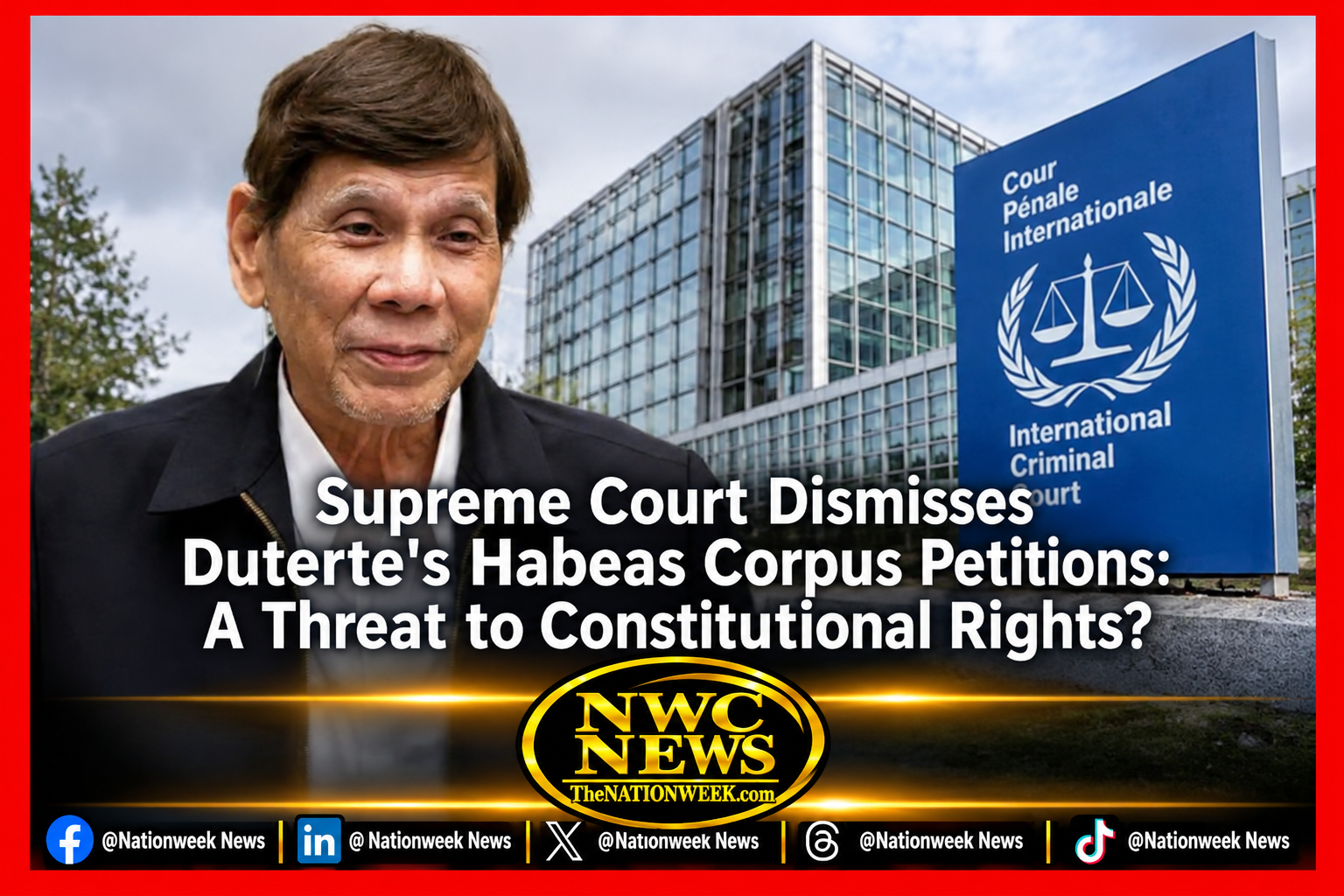
Supreme Court Dismisses Duterte’s Habeas Corpus Petitions: A Threat to Constitutional Rights?

Supreme Court Dismisses Duterte’s Habeas Corpus Petitions: A Threat to Constitutional Rights?

Supreme Court Dismisses Duterte’s Habeas Corpus Petitions: A Threat to Constitutional Rights?

By Bing Jabadan – TheNATIONWEEK.com | November 26, 2026

MANILA, Philippines – A storm of outrage and legal concern has erupted following the Philippine Supreme Court’s (SC) decision to dismiss the consolidated habeas corpus petitions filed on behalf of former President Rodrigo Duterte. 

The unanimous ruling, based on the petitions being “moot” due to Duterte’s current detention at the International Criminal Court (ICC) in The Hague, has triggered a powerful chorus of dissent from the Vice President, legal experts, and Duterte’s counsel, who accuse the High Court of failing to uphold fundamental constitutional rights and protect national sovereignty from potential foreign overreach.

This contentious decision leaves critical questions of due process, executive authority limits, and the fundamental right to liberty unsettlingly unanswered, sparking fears of a dangerous precedent that could undermine the very foundations of Philippine justice.

Vice President Sara Z. Duterte: A Stinging Indictment of Sovereignty and Due Process

Vice President Sara Z. Duterte, in a powerful statement on November 25, 2026, delivered a scathing critique of the Supreme Court’s action, asserting: “No foreign court or nation should ever stand above the sovereignty of our country. The protection of the life, liberty, and fundamental rights of every Filipino citizen must remain paramount.”

Her statement unequivocally rejects the notion that a Philippine court can “lightly dismiss a petition as moot” when the core issues involve “national sovereignty, constitutional accountability, and the government’s duty to protect the life and liberty of every Filipino from foreign interference.” 

Vice President Duterte’s words serve as a potent reminder that the judiciary’s role extends beyond procedural technicalities, demanding a robust defense of constitutional principles that safeguard citizens from undue external influence and governmental overreach. 

Her emphatic closing, “Shukran,” resonates with profound disappointment and a call for introspection within the highest echelons of Philippine justice.

Atty. Israelito P. Torreon: The Writ of Habeas Corpus, Not a Race to the Airport

Atty. Israelito P. Torreon, counsel for former President Duterte and Senator Ronald Dela Rosa in a separate, yet related, pending Supreme Court case (G.R. No. 278747), issued a forceful statement on November 24, 2026, expressing profound disagreement with the majority ruling. While acknowledging respect for the Court, Torreon asserted, “The writ of habeas corpus has never been a remedy that ends at the airport.”

He drew a powerful parallel to the landmark 1919 case of ‘Villavicencio v. Lukban’, emphasizing that officials cannot circumvent the writ by simply moving a detained person beyond the Court’s immediate physical reach. 

Torreon meticulously highlighted that the petitions were not merely concerned with Duterte’s current location but fundamentally challenged the legality of actions taken on Philippine soil on March 11, 2025: “the arrest, the detention at Villamor Air Base, and the transfer out of the country within hours.” 

He underscored the critical absence of a Philippine court warrant for these actions, arguing that the legality of these initial acts remains a question “that only our Supreme Court can answer.”

Torreon expressed deep concern that the Court’s acknowledgment – that dismissing the petitions “does not mean that Duterte’s arrest and transfer were necessarily lawful or that his constitutional rights were not violated” – precisely illuminates the Court’s missed opportunity. 

He powerfully argued, “With respect, that is precisely why the Court should have ruled on the merits. A grave constitutional question was raised, and it was left unanswered.”

Warning of a dangerous precedent, Torreon stated, “If liberty can be taken and carried beyond our borders in a single day, and the speed of the removal is then enough to put it beyond judicial review, the Bill of Rights becomes a promise that depends on how quickly the government moves.” 

He echoed the concerns of the four dissenting Justices and a fifth who wrote separately, highlighting that critical questions may “recur yet may evade judicial review.”

Torreon reiterated his firm’s commitment to pursuing G.R. No. 278747, urging the Supreme Court to “resolve that case at the earliest opportunity,” emphasizing the pressing need for a “definitive answer on whether a citizen may be handed over to an international tribunal without a warrant from a Philippine court and without a law that provides the procedure and the safeguards.”

Atty. Paolo Panelo: The Writ Reduced to a “Race” Beyond Reach

Atty. Paolo Panelo, counsel for petitioner Veronica “Kitty” Duterte, announced on November 25, 2026, their immediate intention to file a Motion for Reconsideration. Panelo sharply criticized the ruling, stating, “With due respect, the decision effectively reduces the great writ of habeas corpus to a race to remove the person detained outside Philippine territory before the courts can act.”

He described the High Court’s decision as deeply disappointing, arguing that it “could weaken the purpose of the writ of habeas corpus, a legal remedy designed to protect individuals against unlawful detention.” Panelo’s statement, “𝐇𝐈𝐍𝐃𝐈 𝐏𝐀 𝐓𝐀𝐏𝐎𝐒 𝐀𝐍𝐆 𝐋𝐀𝐁𝐀𝐍!” (“The fight is not over!”), underscores the legal camp’s unwavering resolve to challenge the circumstances surrounding Duterte’s transfer to the ICC, ensuring that the constitutional and legal controversy remains fiercely alive.

A Missed Opportunity for Guiding Jurisprudence: The Unanswered Questions

The Supreme Court’s 9-4 vote to dismiss the petitions on grounds of mootness, while acknowledging Duterte’s custody by the ICC, has been widely characterized as a profound missed opportunity to establish crucial guiding jurisprudence. 

While the Court’s position on mootness is procedurally understandable, the decision conspicuously avoids a judicial declaration on the lawfulness or constitutionality of Duterte’s arrest and surrender.

This omission is particularly glaring given established jurisprudence allowing the Supreme Court to resolve otherwise moot cases under specific circumstances, notably: when there is a grave constitutional violation, when paramount public interest is involved, when the issue requires controlling principles for the bench and bar, or when the case is “capable of repetition yet evading review.” The third and fourth exceptions, in particular, resonate powerfully with the implications of this ruling.

Fundamental questions remain unaddressed, transcending the individual case of the former President:

  • What precise procedures must Philippine authorities observe in implementing an ICC-issued warrant of arrest?
  • What judicial safeguards are unequivocally guaranteed to a person arrested under such circumstances?
  • How does Section 17 of Republic Act No. 9851 operate within our constitutional framework, particularly following the Philippines’ withdrawal from the Rome Statute?

These are not questions of political allegiance but of legal certainty, constitutional safeguards, and the unwavering rule of law. The Court, in its capacity as the ultimate arbiter of justice, had an opportune moment to delineate the critical parameters of executive authority when effecting arrests and surrenders to international tribunals, especially when the sacrosanct rights enshrined in the Constitution are at stake.

The “remedy may have become moot,” but the urgent “need for doctrinal clarity has not.” The Supreme Court’s decision has, for many, left a gaping void in Philippine jurisprudence, raising a troubling specter of a future where liberty can be swiftly removed from national jurisdiction, potentially beyond the reach of the very courts tasked with its protection. 

The legal battle is far from over, as the petitioners vow to fight for a reconsideration, seeking nothing less than a definitive answer that will shape the future of constitutional rights and national sovereignty in the Philippines.

[Note: AI technology was used to generate the thumbnail.]

*          *          *

Your support fuels independent and fearless journalism.

To advertise with us, please contact us today at: nationweek@yahoo.com.

You can also make a donation via GCash at: +639267015155.

Follow Us On Social Media

Leave a Reply

Back To Top