Saturday, November 21, 2026 - 04:45 AM
Subscribe/Login
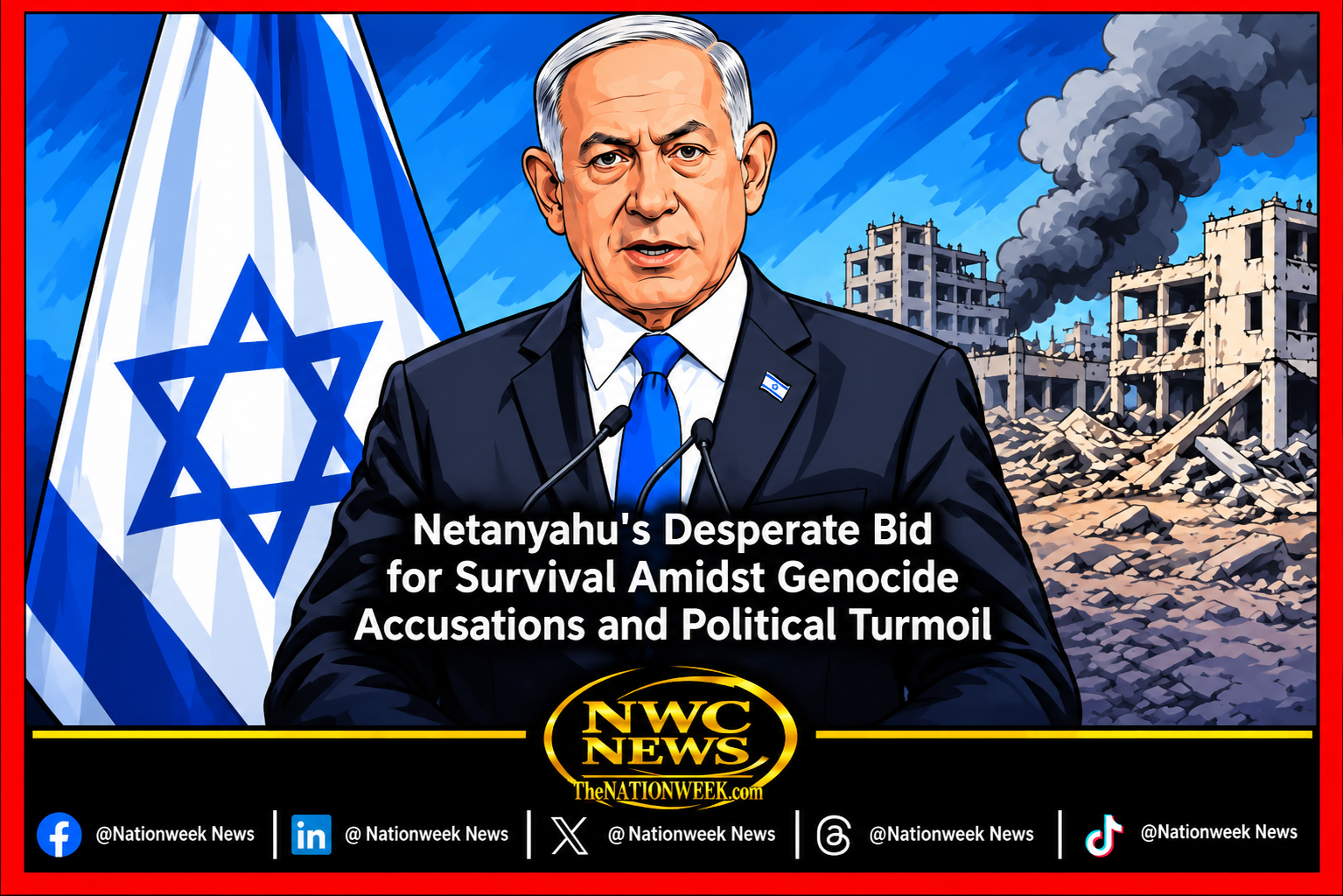
Netanyahu’s Desperate Bid for Survival Amidst Genocide Accusations and Political Turmoil

Netanyahu’s Desperate Bid for Survival Amidst Genocide Accusations and Political Turmoil

Netanyahu’s Desperate Bid for Survival Amidst Genocide Accusations and Political Turmoil

By NATIONWEEK News Desk | November 20, 2026

JERUSALEM, Palestinian Territory – As calls for accountability grow over alleged war crimes in Gaza and a deepening constitutional crisis, Israel’s caretaker Prime Minister faces a perilous political future, marked by escalating tensions and threats to democratic institutions.

In the wake of Israel’s October 27 election, caretaker Prime Minister Benjamin Netanyahu has launched a fervent campaign challenging the legitimacy of the results and assailing his political adversaries. Facing potential political marginalization, Netanyahu’s actions are increasingly viewed as a desperate gambit to retain power, even at the risk of further destabilizing an already volatile region.

This political maneuvering unfolds against a backdrop of intensifying scrutiny over Israel’s military actions in Gaza, which numerous international bodies and human rights organizations have condemned as genocide and crimes against humanity against Palestinians.

The scale of death, displacement, and destruction has fueled global outrage and ignited urgent calls for international investigation and accountability for Israeli leadership.

Netanyahu’s strategy includes baseless accusations of electoral fraud against parties representing Palestinian citizens of Israel, a tactic widely seen as an attempt to tarnish their reputation and delegitimize their participation in forming a new government.

This inflammatory rhetoric has created a climate where right-wing elements openly threaten civil war, and critics accuse Netanyahu of deliberately stoking conflict with Iran to secure his position.

Further underscoring the severity of the situation, reports surfaced alleging that the Shin Bet domestic intelligence agency, led by Netanyahu’s ally David Zini, sought to surveil and arrest Palestinian lawmakers on election day.

These requests, ultimately rejected by the attorney general, have been decried by opposition leaders as evidence of an “attempted coup” and are now subject to investigation for potential fabrication of vote-buying allegations within the Prime Minister’s office.

Analysts and politicians widely interpret Netanyahu’s actions as a singular, overriding determination to cling to power or to engineer a government beholden to his and his allies’ influence.

High Stakes for a Leader Under Siege

Netanyahu confronts formidable threats to both his legacy and personal freedom. Mounting calls for a state inquiry into his government’s failures leading up to the Hamas-led October 7, 2023, attack have intensified.

These demands gained urgency following reports indicating Netanyahu received direct warnings from senior Egyptian and Emirati officials about a potential assault. The establishment of such an inquiry prominently featured on the legislative agenda of the new parliamentary session.

Moreover, the ongoing war in Gaza and the constitutional crisis ignited by Netanyahu’s attempts to undermine judicial oversight have provided a convenient shield against long-standing corruption charges. Accused of bribery, fraud, and breach of trust in three separate cases since 2019, Netanyahu’s trial has faced repeated delays due to his prime ministerial duties. A guilty verdict could result in a decade-long prison sentence.

Ahron Bregman, an Israeli analyst at King’s College London, characterizes Netanyahu as a “wounded animal.” “For him, losing the elections is not just a political but also a deeply personal matter, not least because of his corruption trial, which could result in him being sent to jail. Losing the premiership is losing his shield. Hence, for Netanyahu, nothing is off the table.”

Escalating Risk of Violence

The potential for political violence in Israel has demonstrably increased. Following the election, right-wing protesters converged outside opposition leader Gadi Eisenkot’s residence, warning him against forming a government with Arab-led parties and labeling him a “traitor.”

In a chilling public letter, Rabbi Gedalia Axelrod, a former head of Haifa’s rabbinical court, invoked the religious edict of din rodef – the “law of the pursuer.” This principle was famously used by Yigal Amir to justify the assassination of former Prime Minister Yitzhak Rabin in 1995 over the Oslo Accords with the Palestinians, raising profound concerns about the current political climate.

Ofer Cassif, a member of parliament representing the left-wing Hadash party, warns, “The longer it takes for Eisenkot to form a government, the higher the risk of political violence becomes. Netanyahu is willing to do anything, and I mean anything, to stay in power. He’s a psychopath. People on the right talk about civil war, and I’m not ready to discount that… Netanyahu built a cult around him, and it may easily raise arms against his rivals.”

While the immediate legal repercussions for Netanyahu’s alleged efforts to undermine election legitimacy remain unclear, the implications are significant. Aides accused of disseminating false information to the police could face criminal scrutiny, and Shin Bet chief Zini’s position and the agency’s independence could be fundamentally compromised by alleged participation in subverting the democratic process.

Yossi Mekelberg, a senior consulting fellow at Chatham House, asserts, “Netanyahu battles for his survival and doesn’t care if those around him disappear into oblivion, but he might not succeed this time. He doesn’t care about them, or even his political legacy. All he cares about is survival, about fighting for the next day and trying to cling on, no matter what the cost.”

As Israel grapples with a deepening internal crisis and faces mounting international pressure over its actions in Gaza, Netanyahu’s determined struggle for political survival threatens to plunge the nation into further instability and potentially unprecedented levels of internal conflict.

[Note: AI technology was used to generate the thumbnail.]

*          *          *

Your support fuels independent and fearless journalism.

To advertise with us, please contact us today at: nationweek@yahoo.com.

You can also make a donation via GCash at: +639267015155.

Follow Us On Social Media

Leave a Reply

Back To Top