Saturday, November 21, 2026 - 04:45 AM
Subscribe/Login
Trump, Putin, Xi Issue “Peace Declaration” After Historic Trilateral Summit

Trump, Putin, Xi Issue “Peace Declaration” After Historic Trilateral Summit

Trump, Putin, Xi Issue “Peace Declaration” After Historic Trilateral Summit

By NATIONWEEK News Desk | November 20, 2026

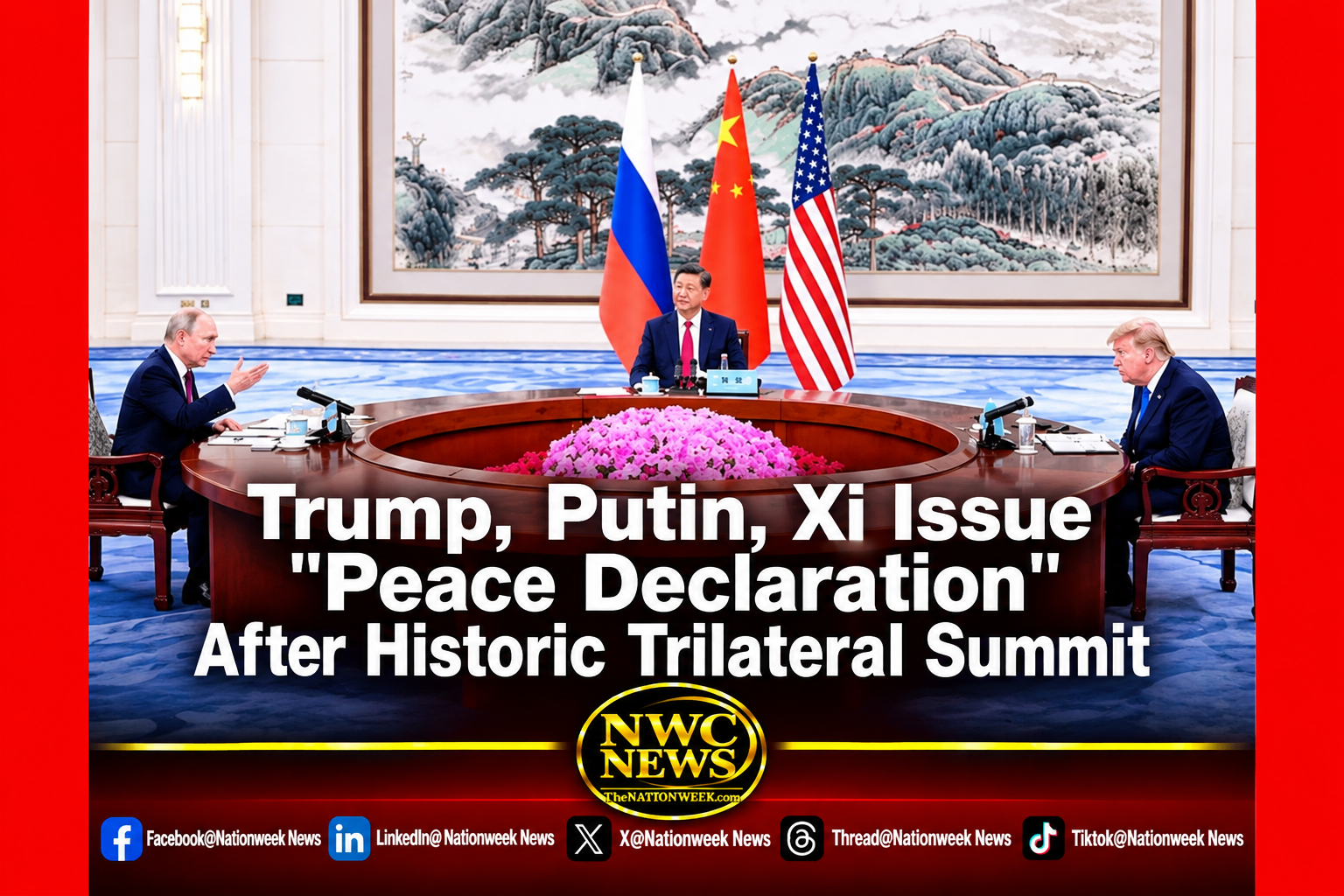
SHENZHEN, China – In a landmark diplomatic event, U.S. President Donald Trump, Russian President Vladimir Putin, and Chinese President Xi Jinping released a “joint declaration of peace” following their first-ever trilateral talks.

The 90-minute meeting occurred on the sidelines of the Asia-Pacific Economic Cooperation (APEC) summit in Shenzhen, China.

The declaration boldly stated, “nuclear war cannot be won and must never be fought,” emphasizing a shared commitment to global stability. The leaders also outlined plans to increase petroleum production and supply and pledged to “reform the UN” to enhance its effectiveness in addressing worldwide challenges.

A significant point in the joint statement addressed the immunity of state officials, with the leaders agreeing that “the International Criminal Court and other similar institutions must not abuse their jurisdiction.”

President Trump lauded the meeting as “a great and highly consequential trip” in a social media post while returning to Washington. He announced a White House news conference for Friday to elaborate on the discussions. Prior to the trilateral, Trump held individual meetings with both Putin and Xi, referring to Putin as his “friend” and describing his relationship with Xi as “very special.”

Underlying Motivations and Divergent Goals

Despite the outward expressions of warmth, observers noted the three leaders arrived with distinct objectives. Chinese President Xi opened the trilateral by emphasizing that “positive interaction among major powers is not a matter of choice, but a mandatory requirement.”

Putin highlighted a shared interest in resolving the Ukraine conflict and discussed food and energy security. China has maintained official neutrality regarding Russia’s 2022 invasion of Ukraine, despite accusations from Kyiv and its allies of tacit support through dual-use technology. Beijing has consistently called for negotiations and a political settlement without condemning Russia’s aggression.

Trump underscored the “special responsibility” of the three nations to maintain productive dialogue. He asserted that past leaders often “avoided talking to nations with whom they had disagreements,” a practice he and his counterparts oppose. Referencing their nuclear capabilities, Trump stated the three nations are “uniquely positioned to discuss how to reduce the number of nuclear weapons on Earth” and “combat the threat of nuclear proliferation in other countries around the world,” specifically citing Iran.

Regarding Ukraine, Trump revealed he and Putin had a “long discussion” and expressed hope that “the other side” desires an end to the war.

Putin’s Post-Summit Remarks Amidst Continued Conflict

Following the trilateral, Putin described the meeting as an “important chapter in the history of diplomacy.” He claimed Ukraine and Europe were not yet ready for compromises to resolve the conflict, stating Russia had invited EU representatives to Moscow to understand Europe’s position. This assertion came as Kyiv was under attack from Russian drones, even as Putin spoke of peace readiness. Putin has consistently rejected Ukrainian ceasefire offers, adhering to maximalist demands that Kyiv and its European allies consider tantamount to capitulation.

In Shenzhen, the Russian leader also vowed “far more painful” retaliation for Ukrainian attacks on the bridge connecting Russia to occupied Crimea, following a recent missile and drone strike that damaged its central road section. Putin made no mention of Russia’s nearly five years of attacks on Ukrainian infrastructure.

Putin also directly addressed comparisons between this summit and the 1945 Yalta Conference, stating, “Nobody divided up the world at Yalta. It simply codified the realities that had emerged after WW2. And when it comes to today’s conflicts, the realities on the ground will have to be accepted.”

Reactions and Interpretations

The Kremlin released a video showing Putin expressing gratitude to Xi for organizing the summit, remarking, “I don’t think anyone even expected everything to go so well.” China’s state broadcaster CCTV quoted Xi describing the meeting as “positive, constructive, and highly productive,” recalling “the history of fighting side-by-side during WW2” and emphasizing “cherishing the hard-won peace.”

The trilateral meeting was reportedly initiated by Putin, with some Russian media outlets calling it a “diplomatic victory” amid Western efforts to isolate Russia following the Ukraine invasion. This summit also marked Putin’s first participation in an international gathering alongside leaders from Canada, Japan, and Australia since the war began.

U.S. lawmakers expressed frustration over Trump’s cordiality with America’s geopolitical rivals. Republican Senator John Curtis acknowledged the commitment that “nuclear war must never be fought” but voiced concern over Trump’s approach, asserting that “Vladimir Putin and Xi Jinping are not our friends.” He cautioned against treating them as having shared values, arguing such an approach “risks undermining our national security, weakening trust with our allies, and sending the wrong message about where America stands.” Democratic Senator Jeanne Shaheen was more critical, stating, “President Trump’s ‘friend’ is a murderous war criminal.”

[Note: AI technology was used to generate the thumbnail.]

*          *          *

Your support fuels independent and fearless journalism.

To advertise with us, please contact us today at: nationweek@yahoo.com.

You can also make a donation via GCash at: +639267015155.

Follow Us On Social Media

Leave a Reply

Back To Top