Friday, November 6, 2026 - 02:09 PM
Subscribe/Login
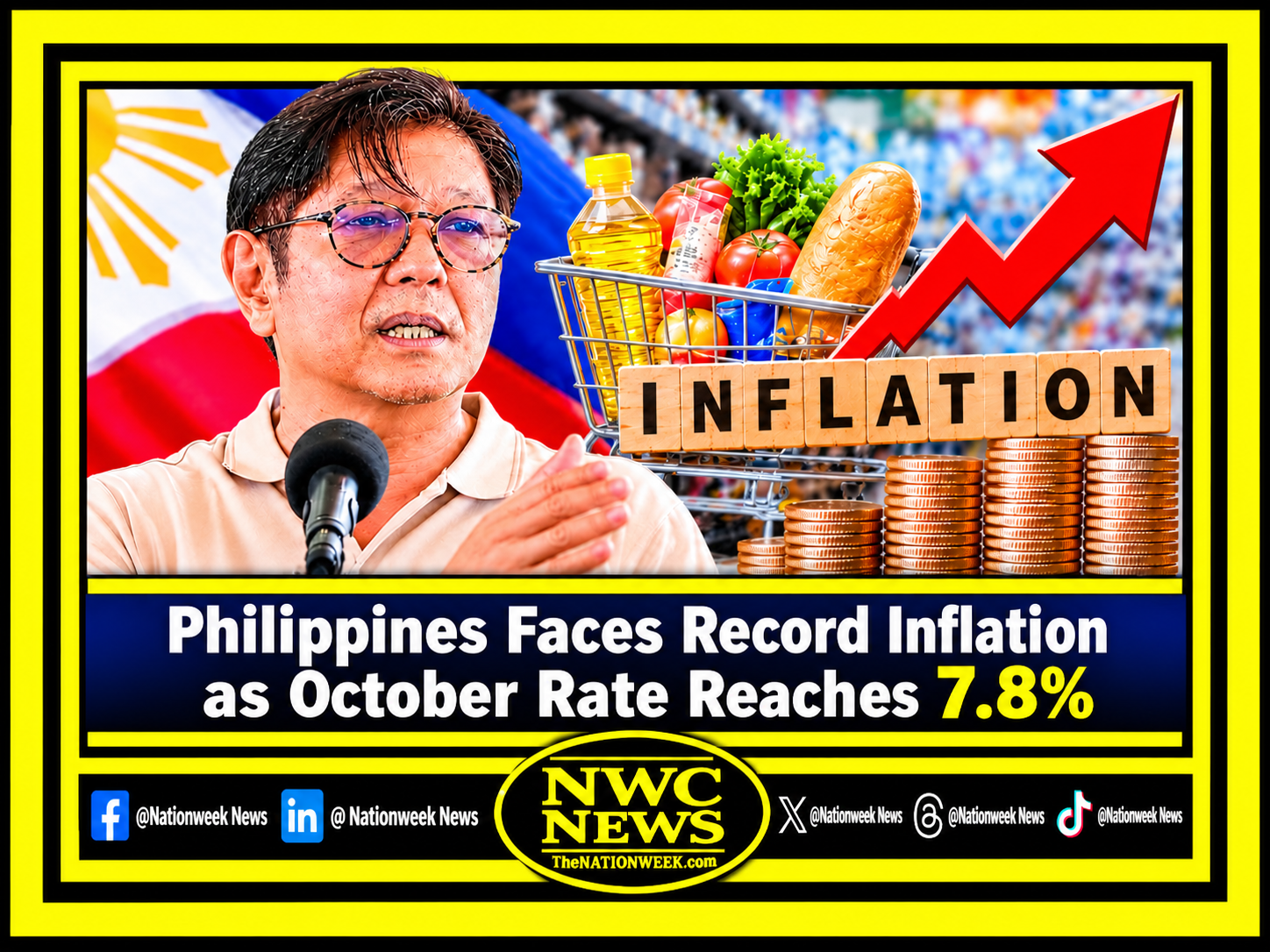
Philippines Faces Record Inflation as October Rate Reaches 7.8%

Philippines Faces Record Inflation as October Rate Reaches 7.8%

Philippines Faces Record Inflation as October Rate Reaches 7.8%

By TheNATIONWEEK.com News Desk | November 6, 2026

MANILA, Philippines – The Philippines confronts a significant economic challenge as its headline inflation rate surged to 7.8% in October 2026, up from 7.2% in September. This marks a dramatic increase from the 1.7% recorded in October 2025, pushing the year-to-date average to a concerning 5.6%.

The latest data from the Philippine Statistics Authority (PSA) highlights the escalating pressure on household budgets and underscores the urgent need for decisive economic action. Core inflation, excluding volatile food and energy, also rose to 5.4% in October from 4.8% the previous month, indicating pervasive inflationary pressures across various sectors.

Key Inflationary Drivers:

October’s inflation spike was primarily driven by a substantial 20.1% annual increase in transport costs, up from 14.6% in September. This was compounded by a 9.3% rise in housing, water, electricity, gas, and other fuels, climbing from 8.4%.

Further contributing to the overall uptrend were accelerated annual increases across several commodity groups:

  • Alcoholic beverages and tobacco: 6.6% (from 6.5%)
  • Clothing and footwear: 3.4% (from 3.3%)
  • Furnishings, household equipment, and routine household maintenance: 5.0% (from 4.7%)
  • Health: 5.9% (from 5.6%)
  • Recreation, sport, and culture: 5.4% (from 5.3%)
  • Restaurants and accommodation services: 7.7% (from 7.0%)
  • Personal care and miscellaneous goods and services: 4.3% (from 4.1%)

Conversely, the food and non-alcoholic beverages index showed a marginal deceleration, recording a 6.1% year-on-year growth, down from 6.7% in September.

Dominant Contributors to Overall Inflation:

The top three commodity groups exerted the most significant influence on the October 2026 overall inflation rate:

  1. Food and non-alcoholic beverages: 30.2% share, contributing 2.4 percentage points.
  2. Housing, water, electricity, gas, and other fuels: 24.8% share, contributing 1.9 percentage points.
  3. Transport: 23.5% share, contributing 1.8 percentage points.

Food Sector Nuances:

While overall food and non-alcoholic beverage inflation slowed marginally, a closer look reveals mixed trends. National-level food inflation registered 6.4% in October, a decrease from 6.8% in September. This was primarily due to slower annual increases in fish (5.0% from 7.4%) and vegetables, tubers, plantains, cooking bananas, and pulses (5.7% from 10.5%).

However, specific food items experienced accelerated price hikes:

  • Rice: 20.7% (from 20.3%)
  • Corn: 19.3% (from 17.3%)
  • Flour, bread, and other bakery products, pasta products, and other cereals: 4.7% (from 4.5%)
  • Fruits and nuts: 10.8% (from 8.7%)
  • Ready-made food and other food products not elsewhere classified: 3.9% (from 3.4%)

Furthermore, the annual price decreases in meat and other parts of slaughtered land animals (2.6% from 2.8%) and milk, other dairy products, and eggs (0.2% from 0.7%) slowed, indicating a reduced pace of price relief in these categories.

Food inflation contributed a substantial 28.8% (2.2 percentage points) to the overall inflation figure. The most impactful food groups were:

  1. Cereals and cereal products (including rice, corn, flour, bread, pasta, and other cereals): 72.5% share, contributing 4.6 percentage points.
  2. Fish and other seafood: 14.0% share, contributing 0.9 percentage points.
  3. Vegetables, tubers, plantains, cooking bananas, and pulses: 9.1% share, contributing 0.6 percentage points.

Regional Inflationary Pressures:

The National Capital Region (NCR) mirrored the national trend, with its inflation rate climbing to 5.9% in October from 5.3% in September. This was primarily driven by increased transport costs (17.2% from 11.5%) and higher housing, water, electricity, gas, and other fuels costs (8.8% from 7.7%).

Areas Outside NCR (AONCR) experienced an even sharper acceleration, with inflation reaching 8.2% in October from 7.6% in September. Transport costs (20.7% from 15.2%), housing, water, electricity, gas, and other fuels (9.6% from 8.6%), and restaurants and accommodation services (9.5% from 8.8%) were the main contributors. Sixteen of 17 regions in AONCR registered higher inflation rates, with the Bangsamoro Autonomous Region in Muslim Mindanao recording the highest at 9.9%.

Undersecretary Claire Dennis S. Mapa, PhD, National Statistician and Civil Registrar General, emphasized the critical need for close monitoring of these inflationary trends. Full data, including provincial and selected city CPIs, is accessible on the PSA OpenSTAT portal.

Labor Group Condemns “Misplaced Priorities” Amid Soaring Costs:

In a scathing rebuke, the labor group Partido Manggagawa (PM) slammed the government’s priorities as inflation continues to erode workers’ purchasing power. PM Chairperson Renato Magtubo highlighted the stark contrast between escalating living costs and proposed budget allocations.

“While workers struggle to put food on the table, congressmen are attempting to insert 7,000 pet projects worth ₱180 billion, primarily for multipurpose halls, into the 2027 budget. Meanwhile, Malacañang defends a ₱4.38-billion allocation linked to presidential son Sandro Marcos, reportedly the largest among the questioned figures,” Magtubo stated.

He asserted, “Inflation is devouring workers’ wages while politicians feast on budget insertions. Billions for political projects, higher inflation for working families! Politicians’ priorities are completely misplaced.”

The labor group contends that the escalating cost-of-living crisis demands urgent economic relief, not political patronage and questionable budget allocations. “Workers see no better purpose for thousands of multipurpose halls than serving politicians’ publicity interests. Public funds must serve public needs, not political dynasties!” Magtubo stressed.

PM reiterated its call for a substantial legislated wage hike, decent and secure jobs, and economic policies that protect workers’ purchasing power. It also demanded full transparency and accountability for all questionable budget insertions.

“Workers need higher wages and better jobs, not bigger pork barrel and patronage politics,” Magtubo concluded.

*          *          *

Your support fuels independent and fearless journalism.

To advertise with us, please contact us today at: nationweek@yahoo.com.

You can also make a donation via GCash at: +639267015155.

Leave a Reply

Back To Top