Thursday, October 22, 2026 - 04:35 PM
Subscribe/Login
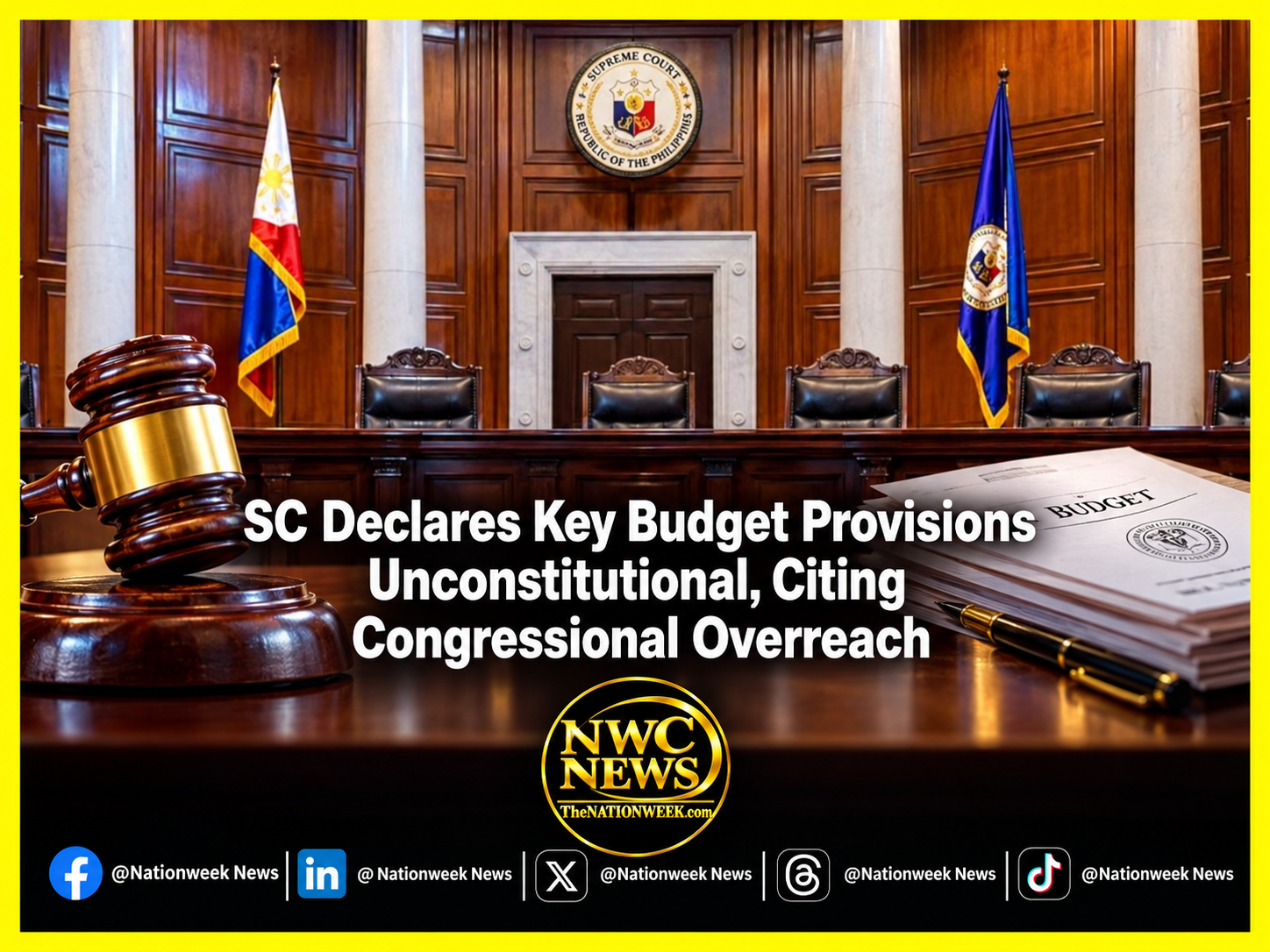
SC Declares Key Budget Provisions Unconstitutional, Citing Congressional Overreach

SC Declares Key Budget Provisions Unconstitutional, Citing Congressional Overreach

SC Declares Key Budget Provisions Unconstitutional, Citing Congressional Overreach

By TheNATIONWEEK.com News Desk | October 22, 2026

MANILA, Philippines – In a landmark series of decisions, the Philippine Supreme Court has declared several key provisions within the 2024, 2025, and 2026 General Appropriations Acts (GAAs) unconstitutional, fundamentally reshaping the balance of power in budget legislation and asserting the judiciary’s role in fiscal oversight. The rulings highlight serious concerns over congressional augmentation of the executive’s proposed budget, particularly regarding unprogrammed appropriations and special funds.

Unconstitutional Budget Increases in 2024 and 2025 GAAs:

The High Court, in a decision penned by Senior Associate Justice Marvic M.V.F. Leonen, granted the petitions of Edcel C. Lagman et al. (G.R. No. 271059) and partly that of Aquilino “Koko” Pimentel III et al. (G.R. No. 271347). This led to the declaration of Republic Act No. 11975, the 2024 General Appropriations Act, as unconstitutional. The Court found that Congress improperly increased the unprogrammed appropriations by a staggering PHP 449.5 billion, directly exceeding the President’s total recommended budget.

Similarly, the Court granted the petition by Filipinos for Peace, Justice and Progress Movement, Inc. et al. (G.R. No. E-02472), declaring Republic Act No. 12116, the 2025 General Appropriations Act, as unconstitutional. This ruling stems from Congress’s PHP 17.99 billion increase to the Special Road Fund of the Department of Public Works and Highways (DPWH), which again inflated the President’s overall recommended appropriations.

Further investigations by the Court revealed that a PHP 12.75 billion increase to certain agencies’ Special Accounts in the General Fund (SAGF) directly violated Book VI, Chapter 4, Section 25 of the Administrative Code, which expressly prohibits increasing special provisions beyond the President’s proposals.

2026 GAA Provisions on Unprogrammed Appropriations Deemed Unconstitutional:

In a partial grant of the petition filed by Edgar R. Erice and Leila M. De Lima (G.R. No. E-04036), the Court also addressed Chapter XLIII of the 2026 GAA, which outlines unprogrammed appropriations. While acknowledging that unprogrammed appropriations are not inherently unconstitutional, the Court underscored the critical need for stringent limits and safeguards to uphold fiscal discipline, transparency, and accountability.

The Supreme Court explicitly ruled that unprogrammed appropriations become “constitutionally infirm” when they lack sufficient standards, effectively granting the Executive unchecked spending authority. This absence of clear guidelines, the Court warned, weakens fiscal discipline and jeopardizes funding for programmed projects when anticipated government revenues fall short. Crucially, the Court affirmed that the budgetary ceiling imposed under Article VI, Section 25(1) of the Constitution applies to the total of both programmed and unprogrammed appropriations.

Court Mandates Strict Conditions for Constitutional Unprogrammed Appropriations:

To ensure the constitutionality of future unprogrammed appropriations, the Supreme Court mandated adherence to the following stringent conditions:

No Lump Sums: Unprogrammed Appropriations shall contain no lump sums.

  • Differentiated Conditions for New Income: Congress must clearly differentiate conditions for utilizing new income and additional non-tax revenue for programmed versus unprogrammed expenditures. While Congress is presumed to prioritize programmed expenditures for new funds, clear and compelling justifications, such as foreign-assisted projects, are required for their inclusion in unprogrammed appropriations.
  • Prioritization Standards: Congress must prescribe sufficient standards for prioritizing spending when multiple purposes exist under Unprogrammed Appropriations.
  • Consistency with National Fiscal Program: The provision for Unprogrammed Appropriations must align with the established national fiscal program and remain consistent with its nature as a narrow, contingent appropriation.

Permanent Injunction Issued:

In a decisive move, the Supreme Court permanently prohibited the Senate, House of Representatives, Office of the Executive Secretary, and the Department of Budget and Management Acting Secretary from implementing Special Provision 1(a) and (b), Chapter XLIII of the 2026 GAA.

Operative Fact Doctrine Applied with Caveats:

Regarding the 2024 and 2025 GAAs, the Supreme Court applied the doctrine of operative fact. However, the Court explicitly clarified that this doctrine only covers irreversible programs where beneficiaries acted in good faith. It does not shield the authors, proponents, or implementors from potential criminal, civil, or administrative liability unless appropriate tribunals explicitly find they acted in good faith.

This series of rulings by the Supreme Court sends a powerful message about fiscal prudence and the separation of powers, underscoring the judiciary’s commitment to upholding constitutional principles in the nation’s budgetary processes.


*             *             *

Your support fuels our fearless journalism.

To advertise with us, please contact us today at: nationweek@yahoo.com.

You can also make a donation via GCash at: +639267015155.

Leave a Reply

Back To Top