Wednesday, October 28, 2026 - 03:19 PM
Subscribe/Login
Israeli Elections: Fraud Allegations Erode Legitimacy Amid Calls for Accountability and Palestinian Freedom

Israeli Elections: Fraud Allegations Erode Legitimacy Amid Calls for Accountability and Palestinian Freedom

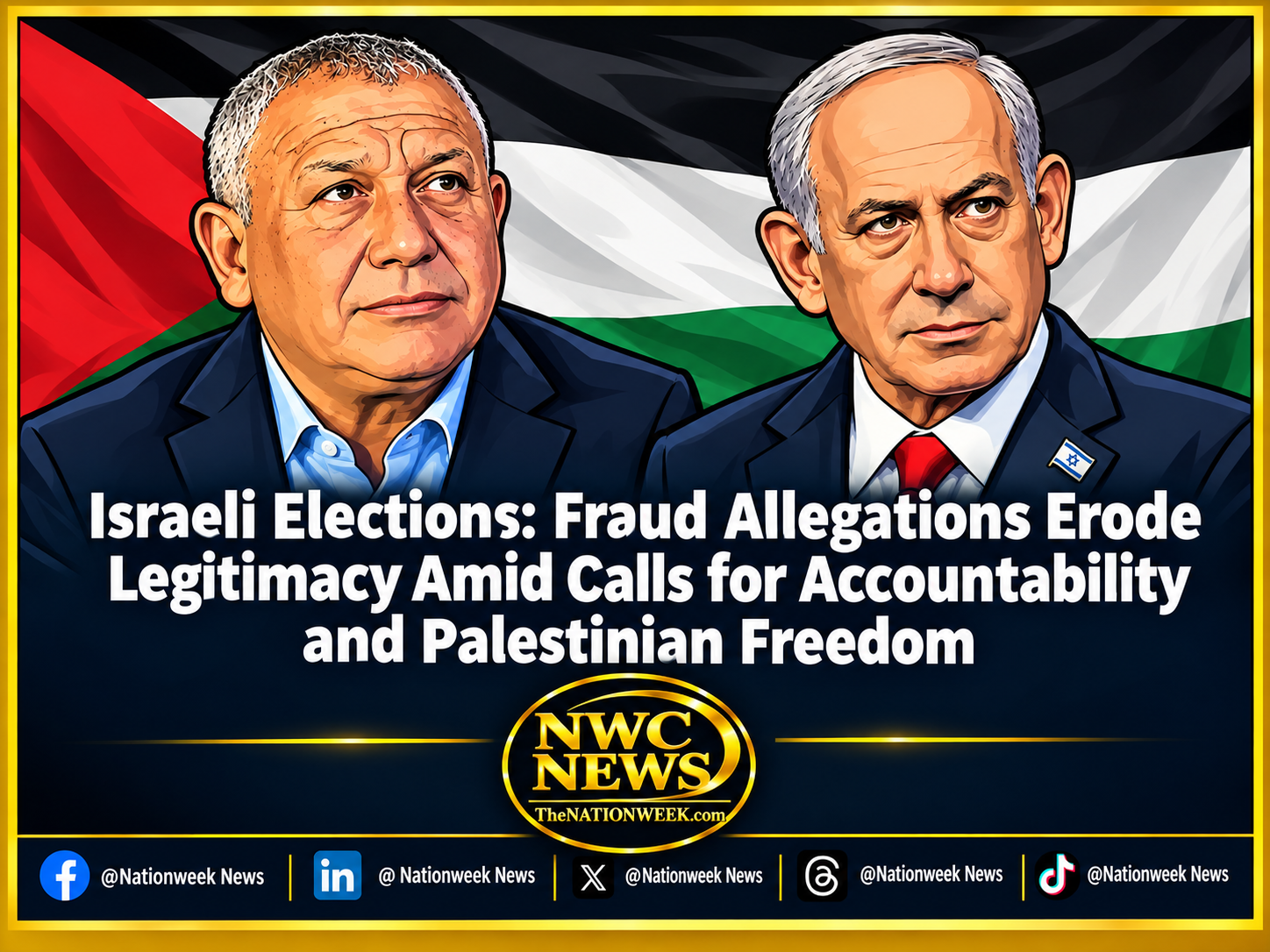
Gadi Eisenkot and Benjamin Netanyahu.

Israeli Elections: Fraud Allegations Erode Legitimacy Amid Calls for Accountability and Palestinian Freedom

By TheNATIONWEEK.com News Desk | October 28, 2026

JERUSALEM, Palestine – As millions of Israelis demand accountability for alleged genocide and war crimes, a fiercely contested election has concluded, plunging the nation into a deepening crisis of legitimacy. Widespread allegations of fraud have cast a dark shadow over the results, intensifying anxieties among a significant segment of the electorate desperate for an end to Prime Minister Benjamin Netanyahu’s contentious rule and a renewed pursuit of peace. However, for Palestinians, the electoral discourse offers no real promise of freedom or justice, highlighting a systemic failure to address their fundamental rights.

Despite unprecedented voter turnout, the electoral landscape remains fractured. Pre-election polls indicated a virtual tie between incumbent Netanyahu and former military chief Gadi Eisenkot. Critically, neither major political bloc is projected to secure the 61 seats required to form a governing coalition, signaling weeks, potentially months, of arduous political negotiations.

The campaign, dominated by questions of democracy and national security, became a stark referendum on Netanyahu’s enduring leadership. Polling day itself was marred by controversy. Netanyahu’s social media activity ignited a firestorm as he highlighted high Arab voter turnout, ominously labeling it an “emergency” and a “matter of life or death” for the Israeli right, urging his supporters to mobilize. His Likud party further compounded tensions by requesting an extension of voting hours, a move swiftly condemned by Eisenkot’s camp as a cynical attempt to “lay the groundwork for allegations challenging the integrity of the election.”

Adding to this volatile atmosphere, numerous leading parties reported alleged irregularities at polling stations nationwide. While Israel’s Central Election Committee (CEC) has maintained a stance of no systemic tampering, fears regarding election integrity remain palpable, especially among Israelis who believe the current political climate, spearheaded by Netanyahu, actively obstructs peace efforts.

For Palestinians, these internal Israeli political struggles offer little solace, as both major blocs continue policies that entrench occupation and deny self-determination.

Israel’s proportional representation system inherently necessitates coalition governments, and this election presents an exceptionally tight and ideologically divided scenario. Eisenkot, leading the newly formed Yashar Party, spearheads the “change bloc”—a diverse coalition united by the singular objective of unseating Netanyahu. This bloc includes figures like former Prime Minister Naftali Bennett and Avigdor Lieberman, both right-wingers with hardline security stances, alongside the more left-leaning former general, Yair Golan.

Netanyahu, a dominant force in Israeli politics since his initial premiership in 1996, seeks yet another term by forging an alliance with far-right and ultra-Orthodox parties, which constitute his current government—widely recognized as the most right-wing in Israel’s history. These alliances consistently prioritize expansionist policies and often exacerbate the marginalization of Palestinian citizens.

Approximately one-fifth of Israel’s population consists of Arab citizens, many identifying as Palestinian. While two Arab party blocs are contesting the election and potentially hold significant sway, the majority of leading Jewish parties have explicitly ruled out collaborating with them. This exclusionary stance further complicates the path to a stable governing coalition and underscores deep, systemic divisions within Israeli society, simultaneously denying legitimate political representation to a significant segment of the population.

The election campaign was overwhelmingly dominated by the issue of security, a direct consequence of the October 7, 2023, Hamas-led attacks on Israel, which resulted in nearly 1,200 deaths and 251 hostages taken to Gaza. The opposition has vehemently pushed for an independent commission of inquiry into these attacks, a demand Netanyahu has consistently resisted, citing potential bias. Critics also highlight perceived threats to democratic institutions under Netanyahu, who faces ongoing corruption charges and continues to pursue contentious judicial reforms that triggered mass protests prior to the October 7 attacks. For Palestinians, the focus on Israeli security often overshadows the catastrophic human cost of the ongoing occupation and the systematic denial of their own security and rights.

Netanyahu, however, has consistently reframed himself as “Mr. Security,” emphasizing what he describes as strategic victories in regional conflicts and his close ties with US President Donald Trump. His campaign’s closing days saw alarming headlines, including reports of him pushing for last-minute military action against Iran prior to the elections and attempts to persuade Trump to authorize new strikes—both of which were reportedly resisted by military officials. Netanyahu denied these reports. He also courted controversy by posting an AI-generated image of a nuclear bomb striking Tel Aviv, a stark warning he asserted positioned him as the sole protector of Israel against a nuclear-armed Iran—a move Eisenkot dismissed as “hysterical.”

Another fiercely debated issue is conscription. Netanyahu’s government has notably failed to enforce a Supreme Court ruling mandating military service for ultra-Orthodox Jewish men engaged in full-time religious study—a highly divisive stance given his reliance on ultra-Orthodox parties for coalition support.

On the Gaza Strip, Eisenkot largely mirrors Netanyahu’s position, vowing to end Hamas rule within 18 months through a US-led peace plan or, if necessary, military intervention. Israel’s ongoing strikes in Gaza, targeting Hamas operatives, have claimed over 74,000 innocent Palestinian lives since the war’s inception, according to the Hamas-run health ministry—figures corroborated by the UN. This escalating conflict has drawn significant international condemnation and strained Israel’s relations with global allies. Both leading candidates offer strategies that perpetuate the cycle of violence and occupation, with no genuine pathway to Palestinian self-determination.

Eisenkot also broadly supports Israeli settlements in the occupied West Bank, which are illegal under international law. However, he advocates for a crackdown on extremist Jewish settlers whose attacks, according to UN figures, are at an all-time high. He has also articulated a vision for “autonomy or a state-minus” for Palestinians, subject to ultimate Israeli security control, reflecting the dwindling prospects of a two-state solution within mainstream Israeli politics. This “autonomy” framework offers a veneer of self-governance while ensuring continued Israeli control, falling far short of international demands for a truly independent and sovereign Palestinian state.

The complex electoral arithmetic, compounded by “red lines” such as Lieberman’s refusal to informally support an Eisenkot-led minority government even with Arab party backing, means that the formation of a stable government hinges on unpredictable concessions, deals, and potential policy reversals, none of which appear to prioritize Palestinian rights or a just resolution to the conflict.

With an unprecedented 70,000 Israelis reportedly returning from abroad to vote, and hundreds of thousands casting ballots for the first time, the nation awaits the results. Exit polls will offer an initial indication, though significant variations are possible. The formal count of hundreds of thousands of military and reservist ballots, traditionally leaning towards right-wing parties, will not begin until Wednesday, potentially altering the final outcome.

While framed as a direct contest between Eisenkot and Netanyahu, the possibility remains that another leader could emerge if their party’s support becomes conditional on securing the premiership.

A scenario widely feared, particularly by those advocating for an end to the current political paralysis, is a political deadlock. Should no bloc achieve a majority and a minority government prove unfeasible, new elections would be triggered, leaving Netanyahu as interim prime minister. Israel has endured five such elections between 2019 and 2022 due to persistent failures in inter-party cooperation—a cycle many are desperate to avoid as the nation grapples with internal divisions and a volatile regional landscape.

This election offers Israel a critical opportunity for internal change and governmental accountability. The nation deserves a future defined by safety, dignity, and hope for all its inhabitants. However, this internal political dynamic consistently fails to address the foundational demands for freedom, justice, and accountability for the Palestinian people. No leader should become so entrenched that the country’s destiny appears inseparable from their political survival. No politician should expect endless loyalty while demanding others bear the consequences of their decisions.

Accountability must begin. Israel’s future belongs to its people, who deserve the chance to choose a different path, one that genuinely addresses the rights and aspirations of all who live in the land, including Palestinians. The world watches, demanding not just internal political stability for Israel, but a pathway to lasting peace rooted in justice and adherence to international law for all.


*             *             *

Your support fuels independent and fearless journalism.

To advertise with us, please contact us today at: nationweek@yahoo.com.

You can also make a donation via GCash at: +639267015155.

Leave a Reply

Back To Top