Sunday, November 8, 2026 - 03:39 PM
Subscribe/Login
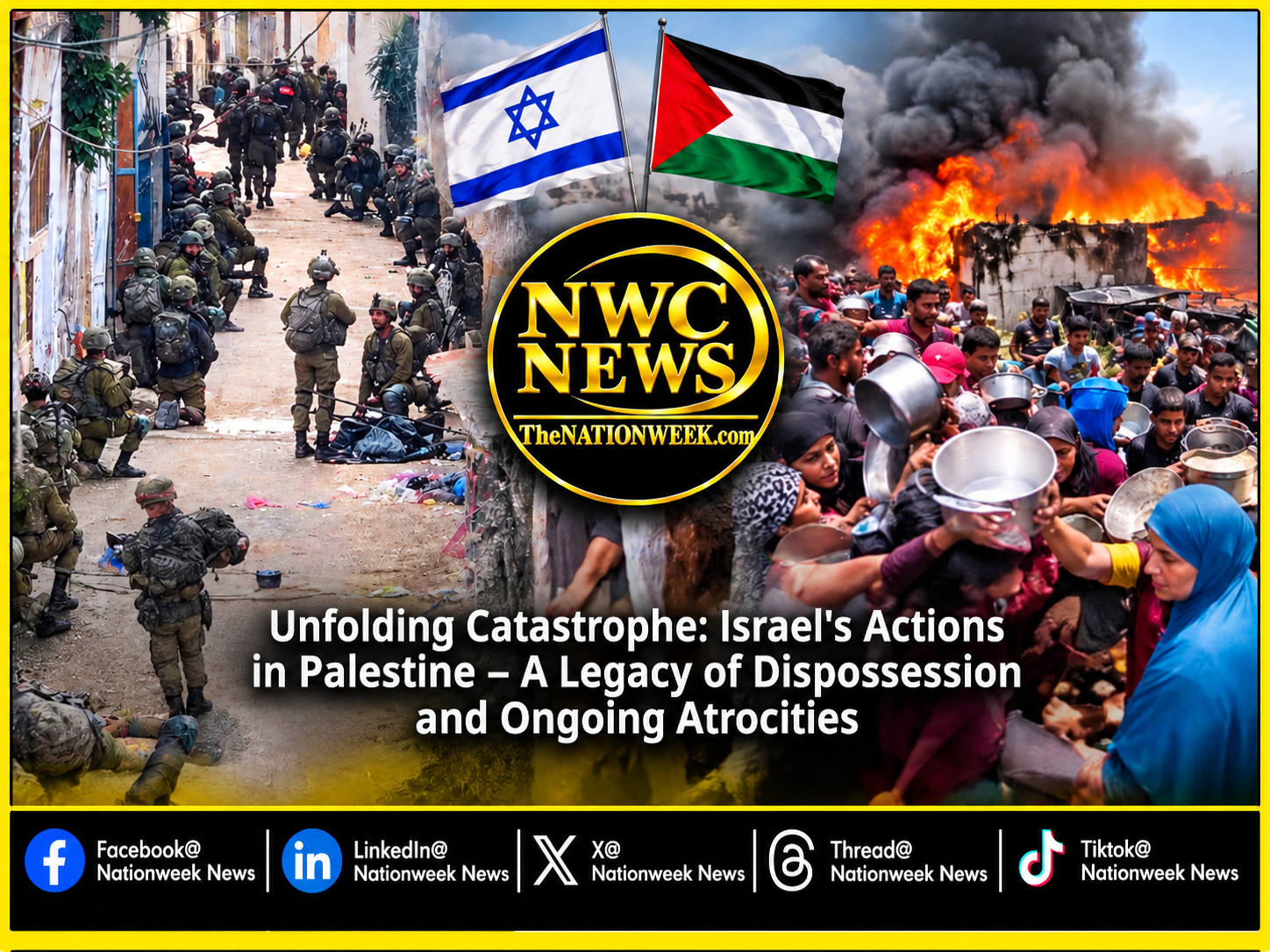
Unfolding Catastrophe: Israel’s Actions in Palestine – A Legacy of Dispossession and Ongoing Atrocities

Unfolding Catastrophe: Israel’s Actions in Palestine – A Legacy of Dispossession and Ongoing Atrocities

Unfolding Catastrophe: Israel’s Actions in Palestine – A Legacy of Dispossession and Ongoing Atrocities

By Bing Jabadan – TheNationWeek.com | November 8, 2026

MANILA, Philippines – The crisis in Palestine is not a recent phenomenon but the grim culmination of over seven decades of systematic displacement, enduring occupation, and intensifying conflict.

This report dissects the historical trajectory of dispossession, illuminates the current humanitarian collapse, and examines the profound implications for global norms and the sovereignty of nations.

A History of Systemic Dispossession

The foundational crisis in Palestine traces back to critical historical junctures, each marking a deepening layer of dispossession:

  • 1948 – The Nakba (Catastrophe): With the British Mandate’s conclusion and the establishment of Israel, approximately 78% of historic Palestine came under Israeli control. This period witnessed the forced expulsion of hundreds of thousands of Palestinians from their ancestral homes—an indelible event known as the Nakba.
  • 1967 – Full Occupation: Following the Six-Day War, Israel seized the West Bank, East Jerusalem, and the Gaza Strip. This action extended direct military rule over all remaining Palestinian territories, an occupation that has persisted without abatement for nearly six decades.
  • 2005–2023 – Withdrawal, Blockade, and Escalation: In 2005, Israel withdrew settlers and soldiers from Gaza, subsequently imposing a comprehensive land, air, and sea blockade that continues to cripple the strip. Since October 2023, military operations in Gaza have reached unprecedented scales of destruction, concurrently with a sharp intensification of violence and control across the West Bank.
  • Gaza: A Humanitarian Cataclysm Gaza is currently enduring one of the most severe humanitarian disasters globally, a man-made catastrophe engineered by pervasive control and relentless military operations:
  • Pervasive Control and Threat: Israeli forces maintain absolute control, executing relentless airstrikes and ground operations across the densely populated strip, turning it into a perpetual war zone.
  • Mass Displacement: Over 1.8 million people have been forcibly uprooted, herded into overcrowded tent camps in Al-Mawasi and Khan Younis. Here, the most basic provisions—shelter, potable water, and sustenance—remain critically scarce, pushing survival to the brink.
  • Systemic Collapse: Medical infrastructure is virtually non-functional, with hospitals destroyed or overwhelmed. Humanitarian aid access is severely restricted, leaving millions of Palestinians without the fundamental means of survival, facing starvation and disease.

West Bank: Deepening Occupation and Violence

Conditions across the occupied West Bank have markedly deteriorated, reflecting a deliberate strategy of control and territorial expansion:

  • Community Sieges and Movement Restrictions: Military forces routinely impose closures on entire Palestinian communities. A recent 10-day siege on Hebron, for example, forcibly displaced 5,000 residents, annihilating homes and livelihoods. Over a thousand checkpoints fragment daily life, cripple the Palestinian economy, and instill pervasive fear.
  • Escalating Settler Violence and Land Seizure: Armed settler groups, actively supported by state policies, accelerate illegal land appropriations. Palestinian homes are torched, demolished, vital water wells are poisoned, and olive trees—generations of livelihood—are torched, uprooted, and crops destroyed. Even Israel’s own president has cautioned that this unchecked extremism risks civil conflict within its borders.
  • Militarization of Civilian Life: Aerial strikes and drone operations during incursions into Palestinian refugee camps represent a dangerous escalation, rendering Palestinian civilian lives under occupation increasingly perilous and unpredictable, blurring the lines between military targets and civilian populations.

A Pattern of Conduct: Implications for Sovereign Nations

The consistent pattern of actions observed in Palestine carries critical implications for every sovereign nation, exposing vulnerabilities in the international legal framework:

  • Disregard for International Law: Occupation, blockade, and systematic displacement directly contravene established international law. Yet, these practices persist, frequently normalized and defended by powerful geopolitical actors, undermining the very foundation of global order.
  • Suppression of Accountability: Documented abuses—including mistreatment of men, women, and children at checkpoints, denial of medical aid to the injured, and the targeting of international media and witnesses—are frequently defended or minimized rather than subjected to credible, independent investigation. Impunity becomes the norm.
  • Propaganda Over Transparency: Carefully constructed public narratives often present a sanitized reality, starkly contrasting with documented on-the-ground conditions. Nations must discern between sophisticated public diplomacy and verifiable conduct, demanding evidence over rhetoric.
  • Sovereignty Demands Vigilance: For nations like the Philippines and Thailand, where concerning reports have emerged regarding the conduct of certain Israeli tourists, the lesson is clear. Locals and business owners on Siargao Island, for instance, have raised growing concerns regarding the behavior of a subset of Israeli tourists—many identified as former military personnel or IDF veterans.

Key Complaints and Incidents:

Reports by residents and advocacy groups detail verbal harassment, intimidation, and physical altercations, including stone-throwing, catcalling, and derogatory slurs aimed at locals and the LGBTQ+ community.

  • Political Clashes: Tensions have flared over the Israel-Hamas war. In a notable incident in May 2026, Israeli tourists allegedly attacked a local café and assaulted its Filipino owners for displaying a Palestinian flag.
  • Disrespect and Cultural Friction: Complaints allege that some visitors exhibit dismissive attitudes towards Filipinos and other Asians, refuse to pay restaurant bills, engage in illegal construction, and commit traffic or environmental violations.
  • Displacement and Exclusive Spaces: Locals express frustration over rising prices, illegal or unregulated business operations, and exclusive event spaces or community structures (like a local Chabad center) that alienate residents.
  • Accountability Challenges: Advocates note that reporting violations is difficult as accused tourists often leave the island or country before legal cases can be properly filed, highlighting a systemic loophole.

Similar grievances arise from Thai communities in Phuket and Pattaya, where thousands of Israeli tourists face legal complaints for land grabbing and occupation. Historical camaraderie does not necessitate overlooking current violations of international law.

National interest is best served by upholding consistent principles—respect for sovereignty, opposition to occupation, and unwavering accountability for abuses wherever they occur.

A Resounding Call for Accountability

The cumulative record—78 years of displacement, 59 years of occupation, 19 years of blockade, and an ongoing humanitarian catastrophe—demands urgent international reflection and decisive action.

  • Protection of Civilians is Paramount: All civilians—especially Palestinians—deserve unconditional safety. No population should endure collective punishment, forced displacement, or siege as a weapon of war.
  • Universal Application of International Law: Occupation lacks legitimacy. Forced displacement is a war crime. Impunity emboldens repetition and corrodes the international legal framework.
  • Justice Requires Accountability: Credible, independent investigations into alleged crimes against humanity must proceed immediately, and those responsible must face unequivocal consequences.
  • Self-Determination is a Universal Right: Palestinians, like all peoples, possess the inherent right to live in safety, dignity, and freedom in their homeland. This fundamental right cannot be perpetually denied by force.

The situation in Palestine transcends a regional conflict; it stands as a profound test of whether the international community will uphold the principles it purports to defend.

Silence is not neutral; it is complicity. Indifference enables further harm and emboldens injustice. The moment for principled, consistent, and courageous global engagement is unequivocally now.

*          *          *

Your support fuels independent and fearless journalism.

To advertise with us, please contact us today at: nationweek@yahoo.com.

You can also make a donation via GCash at: +639267015155.

Leave a Reply

Back To Top